On this page · 12 sections
- The 12 internal linking tools that actually deliver in 2026
- Comparison table 1 — At-a-glance feature matrix
- Comparison table 2 — The WordPress-specific shortlist
- Comparison table 3 — Pricing across the category (2026)
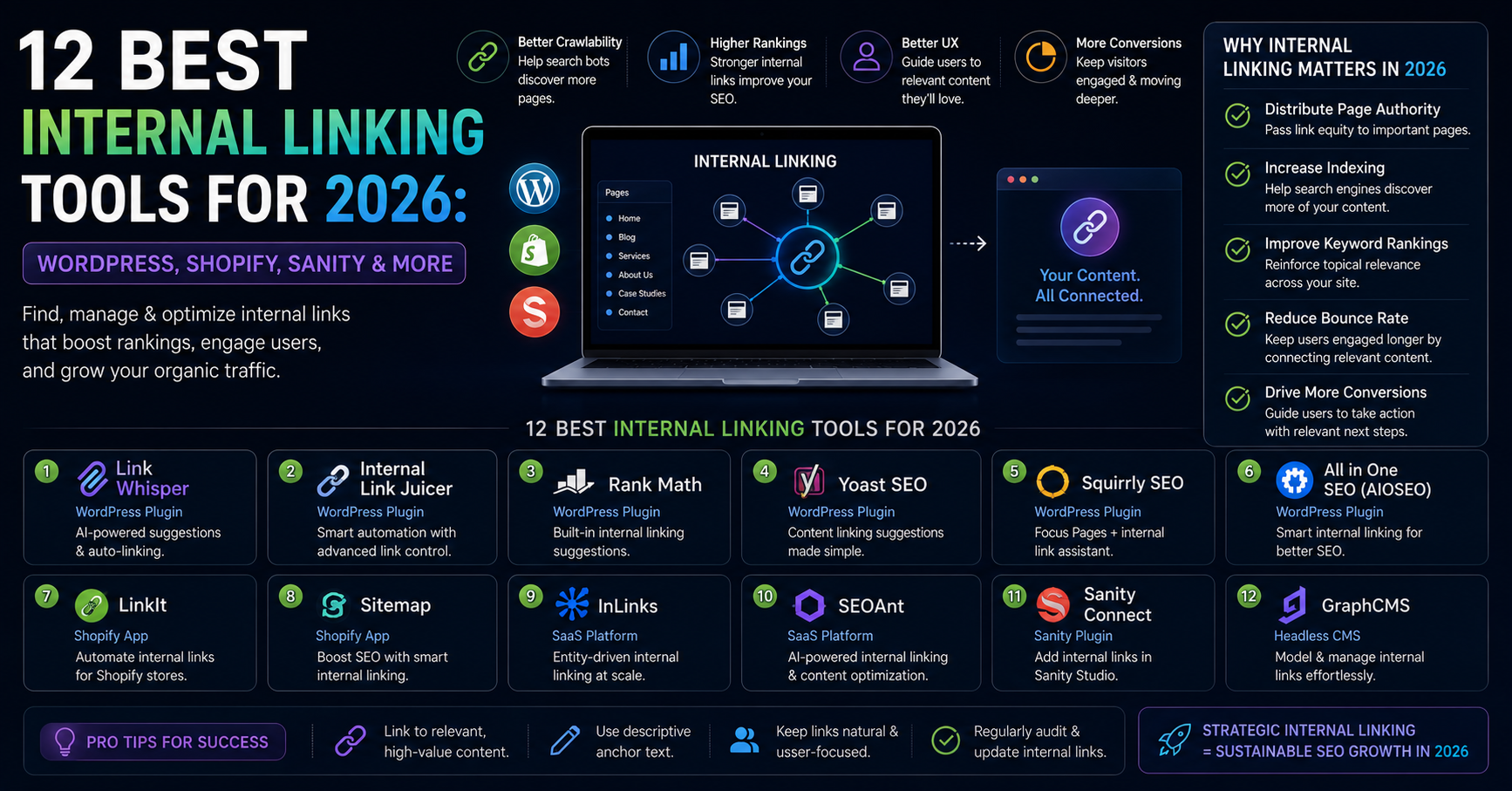
- What internal linking actually does for ranking in 2026
- Internal linking best practices for 2026
- Comparison table 4 — When to use which tool
- How to choose for your platform
- India-specific considerations
- FAQ
- How eCorpIT can help
- References
Summary. Internal linking moved from "nice to have" to a measurable ranking lever in 2026. Industry research shows sites that implement hub-and-spoke topic clustering see AI citation rates climb from roughly 12% to 41% on pillar topics, clustered content drives ~30% more organic traffic than isolated keyword posts, and cluster rankings persist 2.5x longer than standalone pieces. This article surveys the 12 internal linking tools that actually deliver in 2026 — Link Whisper ($97/year, the WordPress mainstay with LLM-powered suggestions), LinkBoss ($140+/month, the bulk-interlinking SaaS choice), Rank Math AI Link Genius (early access, integrated with the Rank Math SEO stack), Surfer SEO (multi-platform, semantic + Google Search Console data), Linkbot (the only listed tool covering WordPress, Shopify, Sanity, and Contentful), Ahrefs Site Audit ($129/month, cloud crawler with internal link health), Screaming Frog (€99-199/month, the desktop SEO spider that defines technical SEO audits), plus Yoast SEO, AIOSEO, Internal Link Juicer, SEMrush, and Machined. Four comparison tables cover at-a-glance feature matrix, WordPress-specific shortlist, pricing across the category, and when to use which tool. The article closes with the 2026 internal linking strategy rules — pillar-cluster architecture, the 3-click rule, anchor text distribution percentages, and link density benchmarks — that determine whether any of these tools actually move the needle.
The honest framing for 2026: no internal linking tool replaces the underlying architecture decision. A site organised around pillar-cluster topic structure with three-click depth and disciplined anchor variation will outperform a site organised around random publishing — regardless of which plugin runs the link suggestions. The tools below execute the strategy faster and with fewer mistakes; they do not invent the strategy.
This guide is built for SEO leads, content marketers, WordPress site owners, ecommerce operators, headless CMS engineering teams, and founders running their own organic growth. The research draws from Link Whisper's product documentation, LinkBoss head-to-head testing, Surfer SEO documentation, Ahrefs Site Audit, Screaming Frog product pages, Shopify's 2026 internal links guide, Semrush, Linkbot, Machined, and the Princeton GEO work covered in eCorpIT's AI Overview Content Strategy guide.
The 12 internal linking tools that actually deliver in 2026
This list is alphabetical so order does not imply ranking. Each entry includes the platform coverage, current pricing, link-suggestion mechanism, and the realistic use case in 2026.
1. Ahrefs Site Audit
Platform: Multi-platform (any site you can crawl). Pricing: From $129/month (Site Audit included on all Ahrefs plans). Link mechanism: Crawl-based analysis, not in-editor suggestions. Best for: Comprehensive internal link health audits, orphan page identification, broken link detection, scheduled monitoring.
Ahrefs Site Audit is the cloud-based crawler with backlink intelligence built in. It scans for technical issues while mapping authority and link equity. Strong on spotting orphan pages, content that is not internally linked, broken links and redirect chains. Internal link health is included as a standard report. It is not a "suggestion engine" you use in the WordPress editor — it identifies what needs fixing across the site, after which you fix links in your CMS.
2. AIOSEO (All in One SEO)
Platform: WordPress. Pricing: From approximately $49.50/year (Pro tier); Link Assistant feature requires the higher tiers. Link mechanism: Pattern matching with keyword-relevance scoring. Best for: WordPress site owners already using AIOSEO who want internal linking inside the existing SEO stack.
AIOSEO's Link Assistant suggests internal links inside the post editor based on keyword relevance and content similarity. It is competent rather than category-leading on link quality, but the integration with the broader AIOSEO suite (schema, sitemaps, redirection) reduces the number of plugins on the site.
3. Internal Link Juicer
Platform: WordPress. Pricing: Free core plugin; Pro tier from approximately $35/year. Link mechanism: Keyword-to-post mapping with automatic insertion. Best for: Hands-off WordPress sites that want rule-based automatic linking.
Internal Link Juicer lets you define which keywords should link to which posts. When those keywords appear in any article, the plugin inserts the link automatically. Strong for category and tag-heavy WordPress sites where the same hub topics are referenced often. Limited semantic intelligence — it relies on the keyword definitions you provide.
4. Linkbot
Platform: WordPress, Shopify, Sanity, Contentful, headless CMS. Pricing: SaaS subscription with tiers based on site size. Link mechanism: AI-powered semantic suggestion + bulk insertion. Best for: Multi-platform companies running content across WordPress, Shopify, and headless CMS.
Linkbot is one of the few tools listed here that covers headless CMS environments. For teams running content marketing on WordPress, ecommerce on Shopify, and editorial on Sanity or Contentful, a single tool that handles all three is operationally meaningful. The AI engine analyses content semantically rather than just pattern-matching keywords.
5. LinkBoss
Platform: WordPress + Shopify. Pricing: From approximately $140/month (annual plans ~$1,679+). Link mechanism: LLM-based semantic analysis with bulk interlinking. Best for: Large sites needing bulk link insertion across hundreds of posts; agencies managing multiple client sites.
LinkBoss is the cloud-based SaaS that competes most directly with Link Whisper. The differentiating feature is true bulk interlinking — creating links across hundreds of posts with a single command. Based on head-to-head testing referenced in LinkBoss's own comparison, the suggested links carry meaningfully higher topical relevance than the closest WordPress competitor. The price is the highest of the WordPress-focused tools and is best justified for sites with 200+ posts.
6. Link Whisper
Platform: WordPress + Shopify. Pricing: From $97/year (single site); higher tiers for agency/multi-site. Link mechanism: NLP-based contextual analysis; as of 2026, uses LLM-powered suggestions via OpenAI API with your own key; content stays on your server. Best for: Individual WordPress site owners and small agencies.
Link Whisper is the longest-running WordPress internal linking plugin and remains the price-performance leader for individual site owners. The editor surfaces relevant inbound and outbound link suggestions while you write. The 2026 version added LLM-powered suggestions using your own OpenAI API key — keeping content on your server while gaining semantic understanding. Click tracking on internal links is a category strength.
7. Machined
Platform: Multi-platform (CMS-agnostic). Pricing: SaaS subscription; tiered by site size and content volume. Link mechanism: AI generation of contextual keyword-optimised internal links across all content. Best for: Programmatic SEO operations and content-as-a-service teams.
Machined automates internal linking at the content-generation layer rather than the post-publication layer. The tool fits teams running programmatic SEO with high-volume content production where post-by-post link insertion would be operationally impossible.
8. Rank Math AI Link Genius
Platform: WordPress (Rank Math users). Pricing: Included with Rank Math Pro tiers; early access as of mid-2026. Link mechanism: AI semantic analysis. Best for: Sites already using Rank Math as their SEO plugin who want internal linking inside the same stack.
Rank Math's AI Link Genius was announced in early access in March 2026 and continues to roll out. It will be the most integrated WordPress option for Rank Math users when generally available — strong on reports and analysis, with the link suggestion engine inheriting Rank Math's content-analysis backbone.
9. Screaming Frog SEO Spider
Platform: Multi-platform desktop crawler. Pricing: €99/month Lite (annual billing), €199/month Standard (up to 5 users). Link mechanism: Desktop crawl with comprehensive internal link reporting. Best for: Technical SEO audits, site migrations, large-scale internal link inventories, agency consulting work.
Screaming Frog is the desktop crawler that defines the technical SEO audit category. For internal linking specifically: complete crawl reports of internal link counts per page, anchor text distribution, broken internal links, redirect chains, and visualisation of site architecture. Not a "fix in the editor" tool — used for the audit-and-plan stage, with the actual link work executed in the CMS.
10. SEMrush Site Audit
Platform: Multi-platform. Pricing: Pro $129.95/month, Guru $249.95/month, Business $499.95/month. Link mechanism: Cloud crawl with internal link analysis. Best for: Teams already using Semrush for keyword and competitor research who want internal link work in the same dashboard.
Semrush combines crawling, keyword research, competitor analysis and reporting in a single interface. Site audits correlate roughly 94% with Google Search Console traffic data. Internal link analysis is a subset of the broader audit; primary strength is in external backlink intelligence, with internal linking as a secondary discipline.
11. Surfer SEO
Platform: Multi-platform (WordPress, Webflow, Squarespace, Shopify, custom sites). Pricing: From approximately $89/month for Essential. Link mechanism: Semantic AI + Google Search Console data to suggest contextually relevant links. Best for: Content marketers writing in Surfer's content editor; multi-platform teams.
Surfer SEO's automated internal linking tool analyses a site's content semantically and uses Google Search Console data to identify how topics relate to each other. The mechanism is one of the more sophisticated on the list — combining semantic similarity with real-world search behaviour data. Strong fit for teams already drafting in Surfer.
12. Yoast SEO Premium
Platform: WordPress. Pricing: Premium from approximately $99/year (single site). Link mechanism: Pattern-matching with content-relevance scoring. Best for: WordPress site owners already on the Yoast stack who want internal linking integrated with the existing SEO workflow.
Yoast Premium surfaces internal linking suggestions in the WordPress editor based on keyword and content similarity. Like AIOSEO, the link suggestions are competent rather than category-leading, but the integration with the broader Yoast suite (readability analysis, schema, redirection) keeps the WordPress site cleaner with fewer plugins.
Comparison table 1 — At-a-glance feature matrix
| Tool | Platforms | Pricing (approx) | Mechanism | Best for |
|---|---|---|---|---|
| Ahrefs Site Audit | Multi | $129/mo | Cloud crawl | Site-wide audit, orphan pages |
| AIOSEO | WordPress | $49.50/yr+ | Pattern-match | WP sites on AIOSEO stack |
| Internal Link Juicer | WordPress | Free / $35/yr | Keyword rules | Hands-off automatic linking |
| Linkbot | WP, Shopify, Sanity, Contentful | SaaS tiers | AI semantic | Multi-platform content teams |
| LinkBoss | WordPress + Shopify | $140+/mo | LLM bulk | 200+ post sites, agencies |
| Link Whisper | WordPress + Shopify | $97/yr | LLM + NLP | Individual WP sites, small agencies |
| Machined | Multi | SaaS tiers | AI generation | Programmatic SEO |
| Rank Math AI Link Genius | WordPress | Rank Math Pro | AI semantic | Rank Math users (early access) |
| Screaming Frog | Multi (desktop) | €99-€199/mo | Desktop crawl | Technical audits, migrations |
| Semrush Site Audit | Multi | $129.95+/mo | Cloud crawl | Teams on Semrush stack |
| Surfer SEO | Multi | $89/mo+ | Semantic + GSC | Content marketers in Surfer |
| Yoast SEO Premium | WordPress | $99/yr | Pattern-match | WP sites on Yoast stack |
Comparison table 2 — The WordPress-specific shortlist
For teams choosing the right WordPress-native plugin, four candidates dominate the buyer conversation.
| Dimension | Link Whisper | LinkBoss | Rank Math AI Link Genius | Yoast Premium |
|---|---|---|---|---|
| Annual cost (single site) | $97 | $1,680+ | Included with Rank Math Pro (~$59+) | $99 |
| LLM-powered suggestions | Yes (own API key) | Yes (cloud) | Yes (cloud) | Limited (keyword-based) |
| Bulk interlinking | Limited | Yes (category leader) | Limited | No |
| Click tracking | Yes | Limited | Yes | No |
| Shopify support | Yes | Yes | No | No |
| Server-side processing | Yes | No (cloud) | Cloud | Yes |
| Integrated with broader SEO suite | No | No | Yes | Yes |
| Best for | Individual sites, small agencies | Large sites, agency portfolio | Existing Rank Math users | Existing Yoast users |
The decision rule that consistently works: if you have under 100 posts and want a competent tool at an individual-site price point, Link Whisper. If you have 200+ posts and need bulk operations across the catalogue, LinkBoss. If you are already on Rank Math, wait for AI Link Genius to leave early access. If you are already on Yoast, Yoast Premium is sufficient unless link quality is critical.
Comparison table 3 — Pricing across the category (2026)
| Tool | Entry tier | Mid tier | Top tier | Pricing model |
|---|---|---|---|---|
| Internal Link Juicer | Free | $35/yr | n/a | Annual licence |
| AIOSEO | $49.50/yr | $99.50/yr | $299.50/yr | Annual licence (Pro→Elite) |
| Rank Math (with AI Link Genius) | ~$59/yr | ~$199/yr | ~$499/yr | Annual licence |
| Surfer SEO | $89/mo | $179/mo | Enterprise | SaaS subscription |
| Link Whisper | $97/yr | $147/yr | $247/yr | Annual licence (1 / 3 / 10+ sites) |
| Yoast SEO Premium | $99/yr | $499/yr | Custom | Annual licence |
| Screaming Frog | €99/mo | €199/mo (5 users) | Enterprise | Annual desktop licence |
| Ahrefs (Site Audit included) | $129/mo | $249/mo | $449+/mo | SaaS subscription |
| Semrush | $129.95/mo | $249.95/mo | $499.95/mo | SaaS subscription |
| LinkBoss | $140/mo | Higher tiers | Agency | SaaS subscription |
| Linkbot | SaaS tiers | SaaS tiers | SaaS tiers | SaaS subscription |
| Machined | SaaS tiers | SaaS tiers | Enterprise | SaaS subscription |
Three pricing patterns worth noting. WordPress plugins on annual licence (Link Whisper, Yoast, AIOSEO, Rank Math) sit far below SaaS pricing for comparable site sizes — usually the right choice for individual WordPress site owners. Audit tools (Ahrefs, Semrush, Screaming Frog) carry higher monthly subscriptions because they deliver value across many SEO disciplines, not just internal linking. Bulk-operation and headless-CMS tools (LinkBoss, Linkbot, Machined) charge premium prices that pay back only on sites with hundreds of posts or multi-platform footprints.
What internal linking actually does for ranking in 2026
Five evidence-backed reasons internal linking remains a primary SEO lever.
Topical authority signal. The dominant content architecture in 2026 is the pillar-cluster model — a broad pillar page covering the topic comprehensively, with tightly-focused cluster pages each handling a subtopic and linking back up to the pillar. Industry research from DigitalApplied reports that sites implementing hub-and-spoke clustering see AI citation rates climb from approximately 12% to 41% on pillar topics, and clustered content drives roughly 30% more organic traffic than isolated keyword posts. Cluster rankings also persist about 2.5x longer than standalone pieces.
Crawl budget concentration. Critical pages should sit within three clicks of the homepage. Pages buried four or more clicks deep face materially higher risk of infrequent crawling and lower perceived importance. Internal linking is the lever that pulls those pages closer to the surface.
Link equity distribution. Strategic linking from your homepage to important category pages and cornerstone content boosts those pages' authority. The PageRank algorithm has evolved enormously since 1998 but the principle of authority flowing through links remains intact.
Disambiguation for AI engines. ChatGPT, Claude, Perplexity and Google AI Overviews use internal link signals to understand which pages on your site are authoritative on which topics. A pillar piece with twenty inbound internal links from related subtopic pages signals "this is the canonical source on this topic" in a way that no on-page optimisation can match.
User experience and engagement. Properly placed internal links extend session length, reduce bounce rate, and direct readers to high-converting pages from informational entry points. The non-SEO operational benefits are real and measurable in any analytics platform.
Internal linking best practices for 2026
Six rules every internal linking program should apply, regardless of which tool you use.
1. Pillar-cluster architecture by default. Every important topic on the site has a pillar piece (3,000-5,000 words, broad coverage) and supporting cluster pieces (1,500-2,500 words on subtopics) that link back to the pillar. The pillar links to relevant clusters. Hub-and-spoke linking concentrates topical authority — the strategy that lifts AI citation rates from 12% to 41%.
2. The 3-click rule. Every important page should be reachable from the homepage within three clicks. Use navigation, hub pages and pillar pieces to keep priority pages shallow. Audit click depth with Screaming Frog or Ahrefs quarterly.
3. Anchor text distribution. Mix anchor types deliberately — research and 2026 industry best-practice converges on approximately 15-25% exact-match anchor text, 30-40% partial-match, 25-35% semantic variants and the remainder generic ("read more", "the full article", URL-only anchors). All-exact-match anchors look unnatural; all-generic anchors lose the relevance signal.
4. Link density. Most SEO practitioners use 2-5 contextual internal links per 1,000 words of body content as a practical baseline. Articles with zero internal links waste authority; articles stuffed with 20+ links dilute PageRank and look manipulative.
5. Total page link count under 150. Including navigation, footer and in-body links. Beyond 150 total links, PageRank distribution per link becomes small enough to materially reduce the effect of any single link.
6. Decision rule for new content. Every new article gets at least three inbound internal links from older relevant pages within two weeks of publishing. Without this discipline, new articles never accumulate enough internal signal to rank for competitive terms.
For the deeper SEO discipline that supports all of this, see eCorpIT's Ultimate Guide to SEO in 2026 and the AEO/GEO/SEO Complete Guide.
Comparison table 4 — When to use which tool
| Use case | Recommended tool | Why |
|---|---|---|
| Individual WordPress site, under 100 posts | Link Whisper | Best price-performance for individual site owners |
| WordPress site, 200+ posts, bulk operations needed | LinkBoss | Only category leader on bulk interlinking |
| Already on Rank Math SEO stack | Rank Math AI Link Genius (when GA) | Integrated; reduces plugin count |
| Already on Yoast SEO Premium | Yoast Premium | Sufficient for most WordPress sites |
| Headless CMS (Sanity, Contentful) plus WordPress and Shopify | Linkbot | Only listed tool covering full headless stack |
| Programmatic SEO operation | Machined | Built for content-as-a-service workflows |
| Multi-platform content marketing (WP + Webflow + Squarespace) | Surfer SEO | Best multi-platform CMS coverage |
| Site-wide audit and link health monitoring | Ahrefs Site Audit | Cloud crawler with internal link health reports |
| Deep technical audit, site migration, large-scale crawls | Screaming Frog | Desktop crawler with maximum control |
| Already running Semrush for keyword and competitor work | Semrush Site Audit | Integrated workflow; no new tool to learn |
| Hands-off automatic linking on a content-heavy WordPress site | Internal Link Juicer | Rule-based automation, low maintenance |
| Existing AIOSEO user, simple linking needs | AIOSEO Link Assistant | Sufficient for sites on AIOSEO stack |
The pattern: WordPress site owners should pick by site size and existing SEO stack. Multi-platform teams should pick by CMS coverage. Audit-and-plan needs are a different category from in-editor suggestion tools — most serious operations need one from each category.
How to choose for your platform
A practical three-question framework.
Question 1 — What CMS are you on?
- WordPress only → Link Whisper (individual), LinkBoss (large/agency), Rank Math AI Link Genius (existing Rank Math users), Yoast Premium (existing Yoast users)
- WordPress + Shopify → Link Whisper or LinkBoss (both cover both)
- WordPress + Shopify + Headless CMS (Sanity/Contentful) → Linkbot
- Multi-platform (Webflow, Squarespace, custom) → Surfer SEO
- Programmatic SEO → Machined
Question 2 — Do you need in-editor suggestions or site-wide audit?
- In-editor suggestions → Link Whisper, LinkBoss, Surfer SEO, Yoast, AIOSEO, Rank Math AI Link Genius
- Site-wide audit and analysis → Ahrefs Site Audit, Screaming Frog, Semrush Site Audit
- Both (typical mature operation) → one from each column
Question 3 — What is your site size?
- Under 100 posts → Link Whisper / Yoast Premium are sufficient; audit annually with Screaming Frog or Ahrefs
- 100-500 posts → Link Whisper + Ahrefs Site Audit; consider LinkBoss for bulk operations
- 500+ posts → LinkBoss for in-editor + Ahrefs or Screaming Frog for audit; programmatic operations consider Machined
India-specific considerations
Three notes for Indian SEO leads and businesses building internal linking discipline in 2026.
Rupee economics favour the annual-licence WordPress plugins. Link Whisper at ₹8,000-13,000 per year (single site) or Yoast Premium at ₹8,000-15,000 per year are materially more accessible than SaaS subscriptions at ₹11,000-30,000 per month. For Indian SMBs and most agencies, WordPress plugins win on cost.
Headless CMS adoption in India. Indian engineering-led brands are increasingly on Sanity, Contentful or custom headless setups. For those teams, Linkbot's multi-platform coverage is the practical pick over WordPress-only tools.
Indian content velocity favours bulk-operation tools. Indian content teams typically publish at higher cadence than US or UK equivalents because of lower production cost. A site that has accumulated 300-500 articles in 18 months benefits disproportionately from LinkBoss's bulk operations or Machined's automated insertion.
For Indian-market SEO strategy, see eCorpIT's digital marketing strategy for 10x ROI in 2026.
FAQ
How eCorpIT can help
eCorpIT runs SEO, AEO and GEO programs for clients across India, the US and the UK — including internal linking strategy and execution, pillar-cluster architecture design, internal link audits, schema implementation, and AI citation tracking via Ahrefs Brand Radar and similar tools.
If your 2026 SEO program needs internal linking discipline that actually moves rankings, our team can help. Reach us at ecorpit.com/contact-us/ or contact@ecorpit.com.
References
- Link Whisper — Official product site: linkwhisper.com
- LinkBoss — Best internal linking tools 2026 comparison: linkboss.io
- Link Whisper — Best Internal Linking Plugin WordPress 2026: linkwhisper.com
- Linkbot — Best Internal Linking Tools 2026 Comparison Guide: library.linkbot.com
- eesel AI — "I tried the 5 best AI internal linking tools in 2026": eesel.ai
- Surfer SEO — Automated Internal Linking Tool documentation: docs.surferseo.com
- Machined — Automated Internal Linking Tool: machined.ai
- Ahrefs Site Audit: ahrefs.com
- Screaming Frog SEO Spider: screamingfrog.co.uk
- Semrush — Best SEO Audit Tools 2026: semrush.com
- SEOTesting — Ten of the Best Internal Linking Tools 2026: seotesting.com
- DigitalApplied — Internal Linking Strategy 2026 Large-Site Guide: digitalapplied.com
- Shopify — Internal Links SEO Best Practices 2026: shopify.com
- Rankability — Are Internal Links a Google Ranking Factor 2026: rankability.com
- eCorpIT — Ultimate Guide to SEO in 2026: ecorpit.com
- eCorpIT — AEO vs GEO vs SEO Complete Guide: ecorpit.com
- eCorpIT — AI Overview Content Strategy 2026: ecorpit.com
- eCorpIT — 20 Best High-DA Free Web 2.0 Sites 2026: ecorpit.com
Last updated 9 June 2026 by the eCorpIT Editorial team. Pricing and feature details are accurate as of publication and may shift; verify with vendor sites before committing to annual or multi-year subscriptions. We will refresh this article when Rank Math AI Link Genius leaves early access and when major vendors release significant updates.