On this page · 15 sections
- The state of B2B marketing in 2026
- What "performance" means in B2B now
- 2026 channel benchmarks
- ABM in 2026: not a tactic, an operating model
- Intent signals: the 5% problem
- The dark funnel and how to measure it
- The modern B2B marketing stack
- AI inside the playbook
- Sales–marketing alignment: the operating compact
- The 90-day playbook
- Common mistakes we see in B2B teams
- What this means for SMBs (especially in India)
- Frequently asked questions
- A short closing note
- References
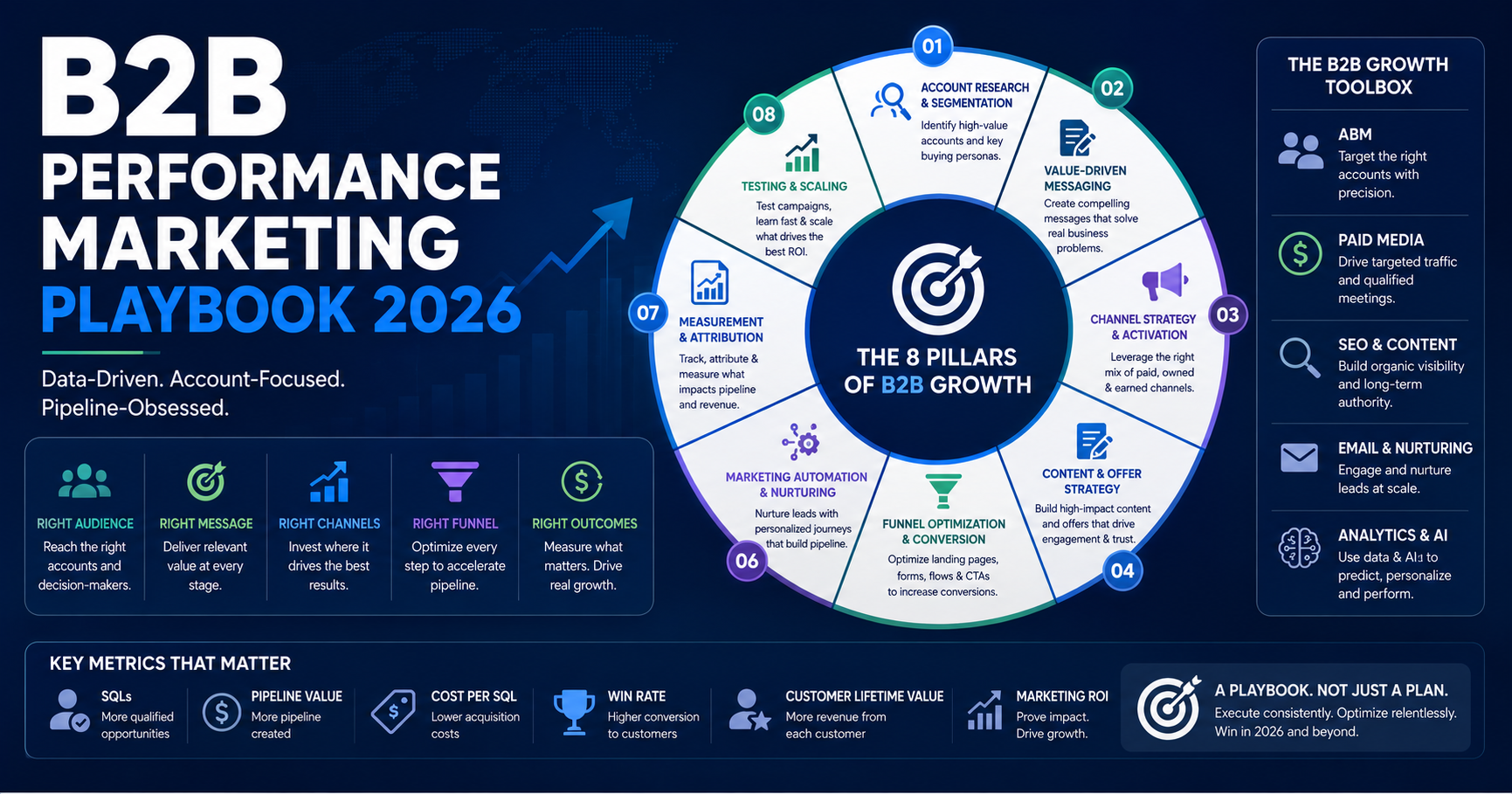
B2B buyers do 70% of their research without talking to a rep, half of them start in an AI chatbot, and the average deal touches 76 surfaces across 211 days. Last-touch attribution is dead. MQL volume is a vanity metric. The teams winning in 2026 build a small, repeatable stack: ABM-tiered targeting, intent signals fed into a sales-marketing operating compact, AI-assisted outbound, and dark-funnel measurement based on incrementality and self-reported sourcing. This is that playbook.
By Manu Shukla, Founder, eCorpIT. Last updated 27 May 2026.
The state of B2B marketing in 2026
A few numbers to anchor the conversation.
Gartner's March 2026 sales survey put rep-free preference at 67% of B2B buyers, with earlier studies pushing as high as 75%. The point of first contact with a sales rep shifted from about 69% of the journey in 2024 to 61% in 2025, roughly six to seven weeks earlier than buyers used to engage. Average buying cycles are down to 10.1 months, from 11.3 the year before.
AI is now a research surface, not a curiosity. 45% of B2B buyers reported using AI during a recent purchase, and 51% start their research inside an AI chatbot rather than a search engine. Decisions are still group decisions: 10 to 11 stakeholders on a typical buying committee. And 84% of buyers end up choosing the first vendor they engaged with. First impression wins more often than best demo.
The other big shift is invisibility. Gartner research suggests 70% of the B2B buying journey now happens in the dark funnel, with the average opportunity touching 76 surfaces across 211 days. Standard 30 or 60-day attribution windows see 20 to 40% of the actual journey. Most teams are flying blind and do not know it yet.
If your 2026 plan looks like your 2023 plan, you are losing pipeline you cannot see.
What "performance" means in B2B now
In B2C, performance marketing meant clicks to checkout. In B2B, that framing breaks. Cycles are long. Buying groups are large. The form fill is a poor proxy for buying intent. A SQL that closes in 11 months is not the same KPI as a Shopify ROAS at 3.
We use a simple working definition with clients: B2B performance marketing is the disciplined investment of media and content spend against revenue, measured at the account and pipeline level, with feedback loops short enough to learn from inside a quarter.
Three implications follow.
The unit is the account, not the lead. You are buying attention from a buying committee, not a single email address.
The success metric is sourced and influenced pipeline, not MQLs. MQLs are still useful as a leading indicator inside a single account, but as a roll-up they have lost most of their meaning.
The cadence is weeks, not campaigns. You optimise on signal density and account engagement movement, not waterfall completion.
If a media plan cannot answer "what is this expected to do to pipeline in 90 days," it is not a performance plan. It is a brand plan with a budget code.
2026 channel benchmarks
The honest answer to "what's a good CPC" is "depends." But ranges help. Here are the medians and good-quartile figures most B2B teams should know.
LinkedIn Ads
The advertising platform B2B marketers still spend most of their paid budget on.
| Metric | Average | Good quartile |
|---|---|---|
| CPC (Sponsored Content) | $5.50–$8.50 | $4.50–$8.50 (Document/Carousel) |
| CTR | 0.44–0.65% | 0.55–0.80% |
| Conversion rate (landing page) | 2.0–3.5% | 4–6% |
| Lead Gen Form CVR | 6.1% | 8%+ |
| Average CPL | $94 | $45 (gated content), $115 (demo) |
Cybersecurity and FinTech CPCs run $12–18. HR Tech and manufacturing run $5–9. ABM-targeted LinkedIn campaigns convert about 2.7× better than broad targeting. Document Ads and Carousel Ads tend to deliver lower CPCs because higher engagement earns better relevance scores.
A practical note: LinkedIn's audience is 310 million monthly active users, against Meta's 3.2 billion. You are paying for precision, not reach. Treat it accordingly.
Google Ads
The other half of most B2B paid budgets.
| Metric | B2B benchmark |
|---|---|
| Average CPC (Search) | $6.29 (up 12% YoY) |
| Cross-industry CPC (Q1 2026) | $2.96 (up from $2.64) |
| B2B conversion rate (Search) | 1.42% average; AI/ML and HR Tech >4% |
| B2B services CPA | $116.13 |
Brand-defence on competitor and category searches still pays back fast. The biggest 2026 shift is intent layering: feeding first-party CRM lists and intent-signal audiences into Google Ads through Customer Match. The same dollar against a stage-aware audience converts at multiples of broad-keyword spend.
Meta and programmatic
Meta is undervalued in B2B. Lookalikes from closed-won deals, layered over job-title filters, produce surprisingly strong demo requests for SMB and mid-market software. Programmatic display works as an air-cover layer for named accounts, mainly to lift branded search and direct traffic, not to drive form fills directly.
Content syndication and review sites
G2, TrustRadius and Capterra are not just review sites. They are intent platforms. The TrustRadius platform serves about 12 million tech buyers annually, and was acquired by HG Insights in June 2025, combining review-based intent with technographic data. Buyers who land on G2 comparison pages are deep in evaluation. The CPL is high. The pipeline conversion is also high.
ABM in 2026: not a tactic, an operating model
Account-Based Marketing has stopped being a side project. Over 70% of B2B marketers now run an active ABM program, and 97% report higher ROI from ABM than from broad demand gen.
The shape of a 2026 ABM program looks like this.
Tier 1 (one-to-one): 10 to 50 named accounts, custom landing pages, 1:1 LinkedIn ad audiences, hand-built outreach, account plans co-owned by marketing and sales. Expensive per account, very high contribution to pipeline.
Tier 2 (one-to-few): 200 to 1,000 accounts grouped by industry, region or use case. Vertical-specific content, programmatic ABM, lighter sales involvement.
Tier 3 (one-to-many): 5,000 to 50,000 accounts in your serviceable addressable market. Always-on display, retargeting, broad LinkedIn job-title targeting, content syndication.
What separates ABM that works from ABM that does not is account selection. Most lists are built on firmographics alone. The ones that perform also weight by fit (technographics, growth signals, hiring trends), intent (third-party intent spikes, first-party engagement) and recency.
A tactical rule that keeps coming up: act on intent spikes within 24 hours. Teams that move that fast see a 29% lift in opportunity creation against slower responders. Most B2B teams have signal pipes that route to CRM but no agreement on who picks up the call. Fix the operating side before you add another data source.
Intent signals: the 5% problem
Only about 5% of B2B buyers are in-market at any given time. The whole point of intent data is to identify which 5%, before they fill in a form, so you can show up in their consideration set.
The 2026 intent stack typically combines three layers.
First-party signals. Visits to pricing or comparison pages, content consumption depth, trial signups, demo abandons, CRM activity from existing customers in target accounts. The richest signals you own. Often underused because they sit in three different tools.
Third-party intent. Bombora, G2 Buyer Intent, TechTarget Priority Engine, 6sense, Demandbase. Each samples different parts of the buyer's research life. None is complete. Layering two providers usually beats trusting one.
Trigger events. Funding rounds, executive hires, technology adoption, layoffs, M&A. These produce more pipeline than most teams give them credit for. A series-B announcement is a buying event for almost every category that sells to growth-stage companies.
The intent data market hit $1.2 billion in 2024 and is projected to grow to $4.8 billion by 2032. That growth is coming from B2B teams learning that signals are cheaper than guesses.
Here is the uncomfortable truth: 91% of B2B marketers use intent data and only 24% report exceptional ROI from it. The gap is almost always operational, not technical. Signal sitting in a dashboard does nothing. Signal routed to a named account owner with a clear next action turns into pipeline.
The dark funnel and how to measure it
Most of the B2B buying journey is now invisible to your analytics. Slack DMs, peer recommendations in private communities, podcast listens, anonymous review-site browsing, comparison queries inside ChatGPT, screenshots forwarded between buying committee members. Gartner's 70% dark-funnel figure is conservative for some categories.
67% of B2B marketing teams still rely on last-touch attribution. That model was always rough. In 2026 it is misleading enough that decisions made on it are usually wrong.
Three measurement approaches work, used in combination.
Self-reported attribution. Add an open-text "how did you hear about us" field to demo request forms. Read the answers. About 30 to 50% of pipeline influence that digital tools miss shows up here. It is not statistically clean. It is closer to the truth than what your MMP tells you.
Signal correlation. Track branded search volume, direct traffic, organic share of voice and third-party mention trends as a basket. When an awareness campaign runs, watch the basket move. The lift is your air-cover working, even when no form gets filled.
Incrementality testing. Run controlled holdouts. Pause a channel in one region or one account tier for a defined window. Measure the pipeline difference. This is the only causal answer to "did this spend actually create pipeline." Most teams do it once a year. The teams ahead do it every quarter on at least one channel.
A note on AI as a research surface. When buyers ask ChatGPT or Perplexity which vendors to consider, that produces no signal in your analytics, but it absolutely shapes shortlists. Treat the AI engines as a media surface and track citation share there too, especially for branded and category-level queries.
The modern B2B marketing stack
The list of tools is long and depends on company stage. The shape is consistent.
Core (everyone). CRM (Salesforce or HubSpot). Marketing automation (HubSpot, Marketo, Pardot). Web analytics (GA4 plus a server-side warehouse). Email deliverability (SPF, DKIM, DMARC, plus a deliverability tool like GlockApps or MailReach if you do high-volume outbound).
Intent and ABM. 6sense, Demandbase or RollWorks for the platform layer. Bombora and G2 Buyer Intent for third-party signals. Champify or UserGems for buyer-tracking when champions move jobs.
Outbound and enrichment. Apollo for raw contact data. Clay for enrichment, research and AI-assisted personalisation. Smartlead or Instantly for sequencing across multiple inboxes. NeverBounce or MillionVerifier for verification.
Content and SEO. A CMS your engineering team will tolerate. An SEO tool you actually open (Ahrefs, Semrush or Sistrix). A schema validator. An LLM-citation tracker if you are serious about GEO.
Measurement. A warehouse (Snowflake, BigQuery, Redshift) where CRM, MAP, ad-platform and product data all land. A BI tool layered on top (Looker, Hex, Mode). A self-reported attribution field in your forms. A quarterly incrementality test calendar.
A small stack you operate well beats a large stack you only half-use. We have seen four-person marketing teams outperform 20-person teams because the four people have the same dashboard open.
Want an honest stack audit? We do paid stack reviews for B2B teams in India, the UK and the US, with a tool-by-tool spend justification and a 90-day consolidation plan. Talk to eCorpIT about a review.
AI inside the playbook
Plenty of vendors will tell you AI replaces SDRs in 2026. The data does not support that. Fully autonomous AI SDRs have shown mixed results at scale. Hybrid models (AI + human) are doing the work.
Where AI is genuinely earning its keep in B2B performance marketing right now.
Outbound enrichment and personalisation. Clay plus Apollo plus an OpenAI key has become a near-standard stack. The unit cost is the headline: roughly $0.05 to $0.20 per email through Clay against about $5 per email for a human BDR doing the equivalent research. 25 to 100× cheaper per message.
Ad creative variation. Generating 30 ad variants per campaign for LinkedIn and Meta from a single brief. Iteration speed is the real benefit. Performance comes from the testing volume that previously was not possible.
Account research at scale. Pulling 10-K filings, press releases, executive interviews and earnings call transcripts into a structured account brief in minutes. Sellers actually read these because they save the seller two hours of pre-call research.
SDR coaching and call analysis. Gong-style platforms now flag the specific talk tracks that correlate with closed-won, not just words per minute. Coaching cycles compress from quarterly to weekly.
Where AI is not yet earning its keep.
Fully automated outbound at scale. The deliverability ceiling is real. Domains burn fast when AI sequences ignore sender warmup, list hygiene and reply detection. Apollo and Clay can write the email. They do not magically fix your IP reputation.
Pure AI-generated thought-leadership content. The Princeton GEO finding holds: AI engines reward statistics, third-party citations and named quotes. Generic AI prose without any of that is not going to get cited inside ChatGPT or Perplexity, no matter how polished it sounds.
The honest framing for AI in 2026 B2B marketing: a force multiplier on the work that you would otherwise hire your way out of. Not a replacement for judgement.
Sales–marketing alignment: the operating compact
Most "alignment" failures are not philosophical. They are operational. Two teams looking at different definitions of the same word.
The compact we use with clients is short, written and signed.
Shared definitions. What is an ICP account. What is an MQL. What is an SQL. What counts as "engaged." What counts as "stale." No more than one page.
Shared lists. A single ICP account list that both teams pull from. Tier 1 / Tier 2 / Tier 3 explicit. Updated quarterly with new triggers and removed accounts.
SLA on signal response. For Tier 1 intent spikes: 24 hours, named owner, defined next action. For Tier 2: 72 hours. For Tier 3: weekly batch.
Shared metric. Sourced and influenced pipeline by account, reviewed weekly together. Not a marketing dashboard sent to sales. The same view, in the same meeting.
Quarterly recalibration. What ICP definitions changed. What channels paid back. What channels did not. What new signals to add. What to retire.
This is unglamorous and most teams skip it. The teams who do it consistently see 1.5–2× more pipeline from the same spend within two quarters.
The 90-day playbook
If you are starting a new role, taking over a function or rebuilding a stalled program, this is the sequence we run.
Days 1–14: instrument and listen.
- Audit the stack. List every tool. List actual usage. List spend.
- Confirm CRM hygiene. If lead source is broken, fix it before anything else.
- Add a self-reported attribution field to every form.
- Read 25 closed-won and 25 closed-lost notes. Write down what you actually heard.
- Talk to three customers and three lost prospects. Write down what they said about your category.
Days 15–45: build the operating layer.
- Lock the ICP. One page. Signed by sales and marketing.
- Build the tiered account list. Pull intent overlays.
- Write the sales-marketing compact. Get it signed.
- Set up signal routing. Tier 1 spikes get a named owner inside 24 hours.
- Reset the dashboard. Sourced and influenced pipeline by account, weekly cadence.
Days 46–75: ship the campaign layer.
- One always-on LinkedIn Sponsored Content campaign per tier.
- One always-on Google Ads campaign on brand and high-intent category terms.
- One content drumbeat: a pillar article a month, a research piece a quarter, a webinar a quarter.
- Outbound program against Tier 1 with AI-enriched personalisation. Volume capped to keep deliverability clean.
- A G2 / review-site presence rebuild if you do not have one.
Days 76–90: prove and plan.
- Run one incrementality test on the highest-spend channel.
- Read the self-reported attribution field outputs.
- Score the program: pipeline created, pipeline influenced, win-rate change, sales-cycle change.
- Write the next 90-day plan with a sharper hypothesis.
That is the loop. Each cycle compounds on the last.
Common mistakes we see in B2B teams
A few patterns that come up almost every audit.
Optimising for MQLs. Volume of MQLs is no longer correlated with revenue in most modern B2B companies. Teams that optimise on MQL targets ship more form fills and less pipeline.
Treating LinkedIn as a brand channel and Google as a perf channel. Both can do both. LinkedIn produces pipeline when you use Lead Gen Forms with stage-aware audiences. Google does air-cover work for branded queries that nobody attributes to advertising.
Ignoring the dark funnel because it is hard to measure. Hard to measure does not mean unimportant. Self-reported attribution and incrementality testing are good-enough proxies. Use them.
Buying intent data and stopping there. Signal that does not have a named owner and a defined response action produces no pipeline.
Letting the stack lead the strategy. "We have HubSpot so we do X" is a tail wagging the dog problem. Pick the strategy. Choose the stack to fit it.
Underinvesting in customer marketing. Existing customers are usually the cheapest pipeline you can create. Expansion, advocacy, references, referrals. Most teams spend 90% of budget on net-new and 10% on customers. Most healthy B2B businesses generate the inverse ratio of revenue.
What this means for SMBs (especially in India)
Most of the playbook above assumes a venture-backed SaaS budget. If you are an Indian SME or a bootstrapped services business selling globally, the same shape applies with smaller numbers and tighter discipline.
Concrete adjustments.
Skip the heavy ABM platform. A clean CRM, an enriched account list and a disciplined sales-marketing weekly review beat a $60,000-a-year ABM platform you are not ready to operate.
Use Clay and Apollo aggressively. The unit economics of AI-assisted outbound are dramatically in your favour. A two-person growth team with Clay can compete with a 10-person outbound team that does not.
Invest in content depth over content frequency. A single 3,000-word pillar a month that ranks and gets cited beats five 800-word posts that do neither.
Pick one channel and dominate. LinkedIn or Google or content. Not all three with thin investment. The 80/20 of your category usually lives in one channel.
Build credibility assets that compound. G2 reviews, case studies with named clients, original research with first-party data. These do not depreciate the way paid spend does.
Operate in INR and quote in USD. Most Indian SMEs underprice. The market will pay USD pricing for USD-quality work.
Frequently asked questions
A short closing note
The hard part of B2B performance marketing in 2026 is not picking the channels. The channels have not changed much. The hard part is the operating discipline: matching spend to accounts, routing signals to named owners, measuring what you cannot see directly, and editing the stack you already have instead of buying more tools.
Most teams know this and still struggle to ship it. That is the gap where outside help pays back.
If you want a second set of eyes on your 2026 plan, that is what we do.