On this page · 16 sections
- The honest opening
- Where the cost savings actually come from
- The numbers worth memorising
- The Klarna case study, including the part most decks leave out
- Vendor pricing reality check
- Build vs buy: the actual TCO math
- The hidden costs nobody quotes
- The deflection ceiling: why almost nobody hits 80%
- CSAT trade-offs: where AI excels and where it fails
- Hallucinations and how to constrain them
- The 90-day implementation playbook
- Common mistakes we keep seeing
- What this means for SMBs, especially in India
- Frequently asked questions
- A short closing note
- References
A well-implemented AI customer service chatbot cuts support costs by 30 to 40% in the first year, deflects 45 to 65% of Tier-1 contacts, and pays back inside 6 to 9 months for mid-market deployments. The Klarna headline of $40M saved is real. So is the part two years later where Klarna quietly brought human agents back for complex cases. The savings depend on a clean knowledge base, honest scope, per-resolution pricing math, and a working escalation path. This article does the actual numbers.
By Manu Shukla, Founder, eCorpIT. Last updated 27 May 2026.
The honest opening
Every chatbot vendor will quote you a slide that says "70% of tickets deflected" and "10× ROI." Some of that is true. Some of it is a benchmark from a single client of a single vendor on a single intent. The averages are smaller and the path is bumpier.
Here is the version we walk clients through.
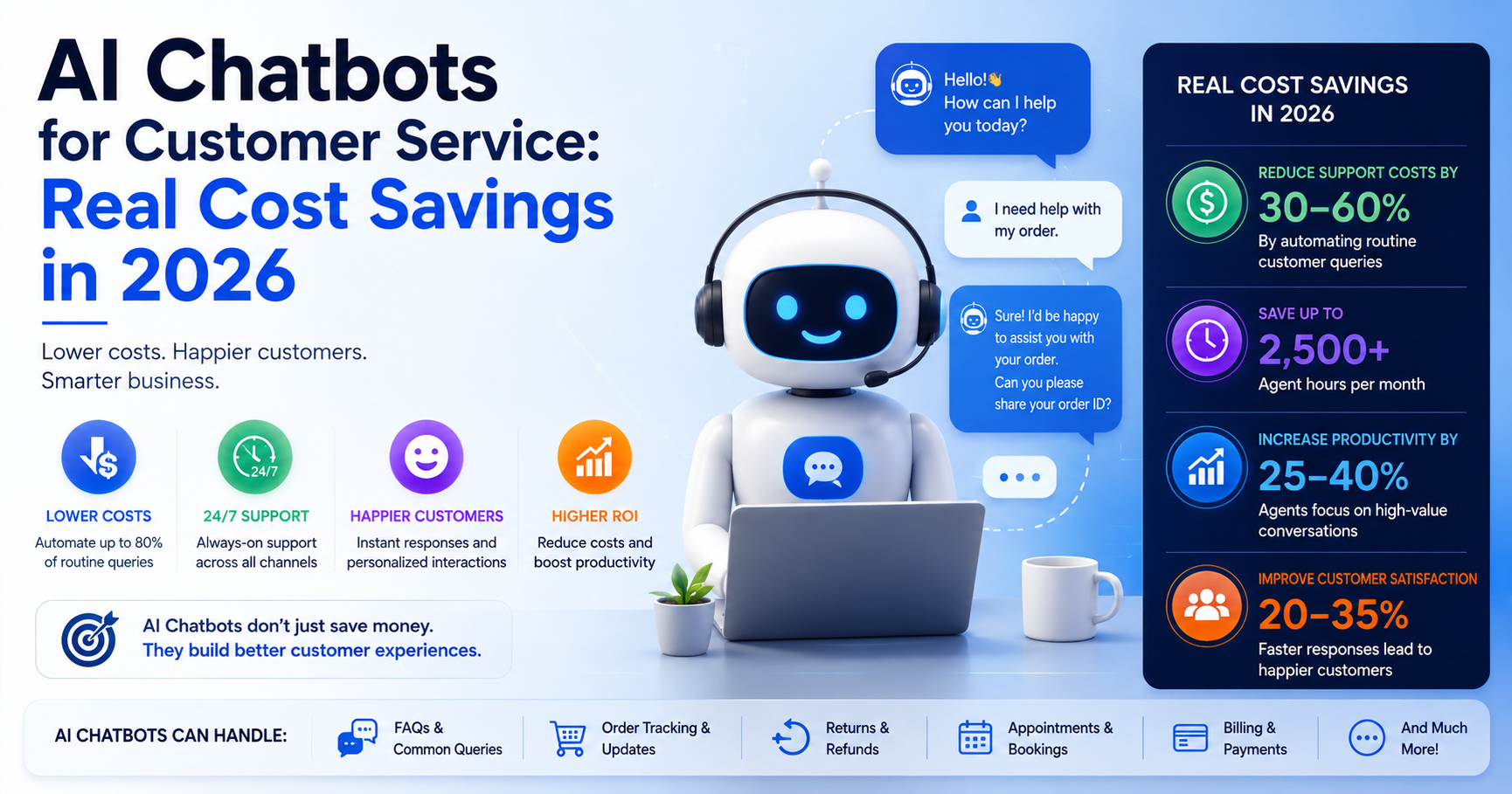
The median AI customer service program in 2026 deflects 41.2% of Tier-1 contacts. The top quartile gets to 58.7%. World-class deployments with a well-maintained knowledge base hit 50 to 70%. Cost savings track the same shape: 30% on average, 53% in the top quartile. First-year ROI averages 340%, or roughly $3.50 returned per $1 spent.
Those are the right numbers to plan against. Not the vendor case study.
The follow-up question, the one most leadership decks skip: where does it stop working? Hallucination rates in customer support chatbots run 15 to 27% in unconstrained deployments, dropping to 0.7 to 1.5% only when the model is held strictly to source material. CSAT for AI-handled tickets sits about 0.2 points below human CSAT on routine intents and significantly below human CSAT on emotional or complex ones. 84% of users still believe a human is more accurate than an AI agent.
Both things are true at once. The savings are real. The limits are real. The teams that win plan for both.
Where the cost savings actually come from
Three buckets, in roughly this order.
Per-contact deflection. The AI handles a Tier-1 ticket end to end. No human touches it. You save the loaded cost per contact (typically $4 to $8 in India, $8 to $15 in the UK and US for chat, higher for phone). At median deflection on a 50,000-tickets-a-month operation, that is real money inside the first quarter.
Handle time reduction on co-pilot tickets. Even when the AI does not fully resolve, it pre-summarises the issue, drafts the response and surfaces the relevant article. Average handle time falls 15 to 30%. Klarna reported customer resolution time dropping from 11 minutes to under 2 minutes on AI-handled chats.
Avoided hiring. The most defensible saving and the hardest to put in a finance spreadsheet. You did not have to hire 20 more agents to support your growth. Klarna sized this at $40M annually, equivalent to about 700 FTEs they did not add during a growth phase.
The unit economics at scale are stark. AI-handled tickets cost 12 to 24× less than human-handled tickets at full run rate. That multiplier compresses to 4 to 6× in year one once implementation, ongoing training and quality review hours are loaded in. Year two is where the savings really show up. Year-2 ROI runs about 4.1× median and 6.7× for the top quartile, as integration is amortised and intent coverage expands.
The 4.2-month median to a first positive quarter is the figure to plan a board narrative around.
The numbers worth memorising
A reference table you can paste into a planning doc.
| Metric | 2026 benchmark | What "good" looks like |
|---|---|---|
| Tier-1 deflection | 41.2% median | 58.7% top quartile, 50–70% world class |
| Year-1 cost reduction | 30% average | 53% top quartile |
| First-year ROI | 340% average | $3.50 per $1 spent |
| Time to first positive quarter | 4.2 months median | Faster with strong KB |
| Payback period (mid-market) | 6–9 months | 3–5 SMB · 12–18 enterprise |
| AI cost per ticket vs human | 4–6× cheaper (Y1) | 12–24× at full scale |
| Hallucination rate | 15–27% unconstrained | 0.7–1.5% grounded |
| AI CSAT | 4.1 / 5 | 4.3 / 5 human · 4.25 hybrid |
| Resolution time impact | 60–80% reduction | Klarna: 11 min → under 2 min |
| Languages supported | 30–95 typical | Klarna: 35+ on day one |
Source citations: Cost and deflection benchmarks from theStacc and Crisp analyses. Klarna metrics from OpenAI and Klarna press releases. CSAT and hallucination data from Unthread and Wonderchat 2026 benchmarks.
The Klarna case study, including the part most decks leave out
Klarna's deployment is the canonical AI customer service case study. It is also widely misquoted. Here is the full arc.
The launch (early 2024). Klarna shipped a GPT-4-class assistant built with OpenAI, integrated into Klarna's account and transaction APIs and grounded in help-centre content. First month: 2.3 million conversations handled, equivalent to about 700 full-time agents. Resolution time dropped from 11 minutes to under 2 minutes. Available in 23 markets, 24/7, 35-plus languages. Klarna sized avoided hiring cost at $40M annually.
The course correction (early 2025). By late 2024 and into 2025, Klarna quietly brought human capacity back for complex cases. The published reasons: hallucinations on edge cases degraded quality on roughly 5% of conversations, CSAT dropped on complex and emotional tickets, and compliance concerns came up around AI autonomously handling disputes and account closures.
The 2026 state. Klarna runs a hybrid model. AI handles the routine, humans handle the sensitive. The $40M saving claim is still defensible. The "we replaced 700 agents" framing has been softened. Internally the team treats this as a sensible recalibration, not a failure.
The lesson is not "do not deploy AI customer service." The lesson is to scope it for the work it does well and design escalation paths that catch the work it does not.
Vendor pricing reality check
Most articles compare list prices and stop. The honest comparison is per-resolution unit economics across realistic volumes.
| Vendor | List price | Notes |
|---|---|---|
| Intercom Fin | $0.99 per resolution | $49.50/mo minimum if standalone (50 resolutions). At least one paid Intercom seat ($29–$139) if used inside Intercom. |
| Zendesk AI agents | $1.50–$2.00 per automated resolution | Plus $50/agent/month Advanced AI add-on. A 20-agent team resolving 3,000 conversations/month: ~$80,000/year all-in. |
| Salesforce Agentforce | $2.00 per conversation | Requires Salesforce Data Cloud to function effectively, which raises total cost of ownership. Built for Service Cloud only. |
| Fini | $0.69 per resolution | Newer entrant, aggressive pricing. |
| Decagon, Sierra, Ada | Per-outcome, not published | Usually negotiated annual contracts. |
At 100,000 monthly resolutions, the gap between Fin ($0.99) and Zendesk ($1.50) is $51,000 per month, or $612,000 a year. At enterprise volumes, the per-resolution price is the only number that matters in the procurement conversation.
A few practical notes from procurement work we have done.
Per-resolution is the right model for most teams. You pay for outcomes, not seats. The unit cost scales with success, which is the right alignment.
The "resolution" definition matters. Read it carefully. Intercom counts a resolution when the customer confirms the answer or the conversation ends without them asking again. Other vendors define it differently. A "resolution" you cannot reconcile against your CSAT data is a useless billing event.
Beware Agentforce's tied-in commitment. Agentforce does not deploy cleanly on top of Zendesk, Intercom or Help Scout. If you are not already on Salesforce, treat Agentforce as a migration commitment to Service Cloud and Data Cloud, not as a standalone AI agent decision.
Build vs buy: the actual TCO math
The build-vs-buy question gets asked at almost every kick-off. The honest answer is "buy, unless you have a very specific reason."
Buy (SaaS).
- Standard plans: $30–$500 per month for SMB-scale bots.
- Enterprise plans (Zendesk AI, Intercom Fin, Salesforce Agentforce): $20,000–$50,000 per year all-in.
- One-time onboarding: $2,000–$10,000.
- Pros: fast, predictable, model upgrades included.
- Cons: per-seat and per-resolution scaling can compound, your workflows must fit the vendor's model.
Build (custom).
- Initial development: $10,000–$75,000+ for design, data prep, model training, integration.
- Ongoing: $10,000–$50,000 per year for retraining, infrastructure, API usage.
- Annual maintenance: 15–20% of initial build cost.
- Pros: full control, differentiation, no per-resolution scaling.
- Cons: long ownership of technical debt, you become the AI vendor.
About 60% of enterprises now go SaaS for speed and predictability. The 40% that build custom usually have a specific differentiation, a compliance constraint that rules out third-party data sharing, or volume large enough that the per-resolution math flips against SaaS.
A useful threshold rule: if you are doing under 100,000 resolutions a month and you do not have a hard compliance reason to self-host, the buy decision is right. Above 250,000 resolutions a month, run the math both ways.
The hidden costs nobody quotes
The advertised price is half the bill.
Human agents for the 35–50% the AI cannot resolve. $29–$169 per agent per month, depending on tier. If you are at median deflection (41%), you still need human capacity for 59% of contacts. The "we will replace all our agents" framing rarely survives contact with production.
Knowledge base maintenance. 5 to 15 hours a month, by a senior CX person who knows the answers. Outdated docs are the single biggest reason deflection rates collapse from 60% to 40%. We have seen six-figure chatbot investments deliver disappointing numbers entirely because the knowledge base behind them had not been refreshed since 2022.
Migration costs if you switch vendors later. $3,500 to $17,000 in our experience for a clean re-platforming, more if intent training is non-portable.
Add-on stacking. AI features, branding removal, additional channels, WhatsApp at 11 cents per marketing message, AI tokens, agent licences, PIM integrations. Each looks small. They add up.
Quality review hours. Someone has to read AI-handled conversations and flag the bad ones. Plan for 2 to 5% of resolved tickets sampled weekly for the first six months.
A fair year-one TCO for a mid-market deployment lands at 1.5 to 2× the list-price quote. Plan accordingly. The savings still pencil out at that loaded number, which is the actual point.
The deflection ceiling: why almost nobody hits 80%
Vendors love to quote 80%. The intent coverage of a real production deployment usually peaks much lower than that and for instructive reasons.
About 20 to 30% of your contact mix is genuinely outside what an AI agent can resolve cleanly: billing disputes that need an exception, complex multi-account scenarios, emotionally charged cancellations, regulated decisions (loan, insurance, healthcare consent), and the long tail of intents that show up once a quarter.
Your knowledge base also drives the ceiling. AI agents can only resolve what you have documented somewhere they can read. Most companies have under-documented their actual support reality by 30 to 50%. A KB refresh is usually the highest-ROI single project in the first six months of a chatbot deployment.
Last, the customer's tolerance for self-service has limits. 84% of users still believe humans are more accurate. Push them too hard into AI and you trade short-term deflection for medium-term CSAT damage. The number to maximise is not deflection. It is deflection times CSAT divided by escalation friction.
A deflection target between 50 and 60% is healthy for most B2C operations. Between 35 and 50% is healthy for most B2B operations, where ticket complexity is higher. If your vendor is targeting much higher and your CSAT is staying flat, ask hard questions about whether the resolution count is reflecting reality.
CSAT trade-offs: where AI excels and where it fails
Pure-AI CSAT lands around 4.1 out of 5. Pure-human CSAT lands around 4.3. Well-designed hybrid (AI with one-click human escalation) narrows the gap to about 0.05 points.
The intent-level breakdown is more useful than the average.
AI does well on structured, factual intents.
- Password reset: 4.41 CSAT
- Refund status: 4.32
- Order tracking: typically 4.3+
- Account information lookup: typically 4.3+
AI does poorly on sentiment-heavy intents.
- Complaint handling: 3.34
- Billing dispute: 3.61
- Cancellation requests with emotion attached: typically below 3.5
The implication is route, not replace. Send factual intents to AI. Route sentiment to humans. Let the AI summarise and triage. Most teams that do this well are running an intent classifier that decides routing before the customer even gets to the agent surface.
Organisations that implement AI with seamless human escalation see 92% of customers report satisfaction with chatbot interactions. Without a working escalation path, the same AI shipping the same answers produces angry users and refund-rate spikes. The escalation path is not an add-on. It is the product.
Hallucinations and how to constrain them
Hallucination rates in customer support chatbots run 15 to 27% in unconstrained deployments. The same models, constrained to summarise only from a provided source, drop to 0.7 to 1.5%.
That is the entire engineering problem in one sentence.
Practical constraints that work.
Retrieval-augmented generation (RAG) over your knowledge base. Do not let the model answer from training data. Pull the relevant article. Instruct the model to answer only from the retrieved content. If the article does not contain the answer, the bot says so and escalates.
Confidence thresholds with hard escalation. Below a defined confidence score, the bot does not answer. It escalates. Better an honest "let me get a human" than a confident fabrication.
Tool use over freeform generation for transactional intents. Refunds, account lookups, order status. The bot calls a function against your APIs and returns the result. There is no room to hallucinate when the answer comes from a database call, not a generated paragraph.
A monitored escalation queue. A small CX ops team reviews every AI conversation that flipped to a human, weekly. Patterns surface fast: missing KB articles, intent classifier gaps, prompt regressions.
Public-facing AI labelling. "You are chatting with our AI assistant. Type 'agent' any time to reach a human." Mandatory in the EU under transparency rules. Just good practice everywhere else.
Hallucination-related complaints account for only 0.34% of AI-handled tickets in current deployments, but 71% of CX leaders rank them as a top-three governance risk because each incident is publicly costly. Twitter and LinkedIn screenshots of a bot saying something embarrassing tend to outlast the savings story by a long time.
The 90-day implementation playbook
If you are launching from zero, this is the sequence we run with clients.
Days 1–14: scope and baseline.
- Pull 90 days of historical contacts. Run intent analysis. Identify the top 20 intents and what percentage of volume they each cover.
- Score each top-20 intent on AI suitability (structured vs sentiment-heavy, transactional vs judgement-based).
- Audit the knowledge base. Mark every article as current, stale or missing. Most teams find 30 to 50% of articles need an update.
- Capture baseline: cost per contact, CSAT by channel, average handle time, deflection from existing IVR or help-centre search.
Days 15–45: select, configure, ground.
- Pick a vendor based on per-resolution math at projected volume, not list price. Read the resolution definition.
- Refresh the knowledge base on the top 20 intents first. Defer the long tail.
- Configure RAG. Confidence thresholds. Escalation paths. Public AI labelling.
- Build the intent-routing layer. Decide which intents the AI ever sees.
- Set up the quality review process. Who reads conversations, how often, what gets actioned.
Days 46–75: pilot and tune.
- Launch to a controlled segment, 10 to 25% of traffic.
- Daily standups on intent gaps, KB additions and escalation rates.
- Weekly deflection report, weekly CSAT report by intent, weekly hallucination audit.
- Tighten the intent classifier where AI-handled CSAT is below threshold.
- Document every escalation reason. Turn the top five into KB updates.
Days 76–90: scale and report.
- Expand to full traffic on confirmed-stable intents.
- Hold higher-risk intents (cancellations, disputes, complaints) in the human queue for now.
- Build the unit economics report: cost per contact pre vs post, deflection, CSAT delta, payback projection.
- Present to leadership with the honest number, not the vendor number.
That cadence is repeatable. Quarter two adds the next 10 to 15 intents. Quarter three adds voice. Quarter four expands languages.
Need help running this for your CX team? eCorpIT runs 90-day AI customer service rollouts for B2B and B2C teams in India, the UK and the US. We do the vendor selection, the KB refresh, the prompt and RAG configuration, the quality review setup and the unit-economics reporting. Book a scoping call.
Common mistakes we keep seeing
A short list of patterns that derail otherwise healthy deployments.
Picking the vendor before doing the intent analysis. You end up paying premium pricing for a feature surface you do not need.
Letting the model answer from training data. Without RAG and grounding, hallucination rates stay above 15%. The savings disappear into refund processing and reputation damage.
Targeting deflection over deflection-times-CSAT. Aggressive deflection tanks satisfaction. The right metric is the joint product, weighted by escalation friction.
Outdated knowledge base. The single biggest determinant of deflection rate. We have seen six-figure deployments produce 35% deflection because the KB had not been touched in two years.
No escalation discipline. A bot without a one-click human path is a bot that produces angry users. Make escalation prominent and frictionless.
Counting "resolutions" the vendor's way instead of yours. Reconcile the vendor's resolution count with your own CSAT and refund data monthly. Mismatches happen.
Replacing the team before validating the model. Headcount reductions before quarter-two performance is in are how programs blow up publicly.
What this means for SMBs, especially in India
The Klarna-scale economics do not apply to a 30-agent SMB operation. The principles do.
A few honest adjustments for cost-sensitive teams.
Start with one channel and three intents. Pick the highest-volume, most structured intents you have. Ship those well. Expand once the unit economics are proven.
Use off-the-shelf, not custom. Below $20M ARR there is rarely a case for a custom build. Intercom Fin, Zendesk AI or one of the lower-cost entrants (Fini, eesel, Tidio) cover most needs at 3 to 5 month payback.
Refresh the knowledge base before you sign the contract. The KB drives the deflection rate. Spending three weeks on a KB refresh before you turn the bot on usually doubles year-one savings.
Run in Hindi and English from day one if you serve Indian customers. Modern LLMs handle Indian languages well now. Do not default to English-only.
Cap the project at 10% of CX headcount cost in year one. That ceiling forces honest scoping. Most disappointed buyers spent 20 to 30% on the platform and 0% on the operating discipline.
Quote in resolutions, not seats, in your business case. Your CFO will thank you in year two.
Frequently asked questions
A short closing note
The numbers in this article are not the cheerful version. They are the version that actually pencils out in a board meeting once procurement, finance and the head of CX have all asked their hard questions.
The savings are real. So are the operational demands. The teams that get this right treat AI customer service as an operating model decision, not a tool purchase.
If you want a sanity check on your business case, that is what we do.