On this page · 15 sections
- Why "finally"
- The market reset that had to happen
- What is actually driving digitization now
- The phygital model won
- What "going digital" actually means for a school
- AI in the Indian classroom: signal versus noise
- The Tier 2 and Tier 3 surprise
- The infrastructure reality
- The new funding and business landscape
- What schools get wrong
- The 90-day school digitization playbook
- What this means for founders, educators and operators
- Frequently asked questions
- A short closing note
- References
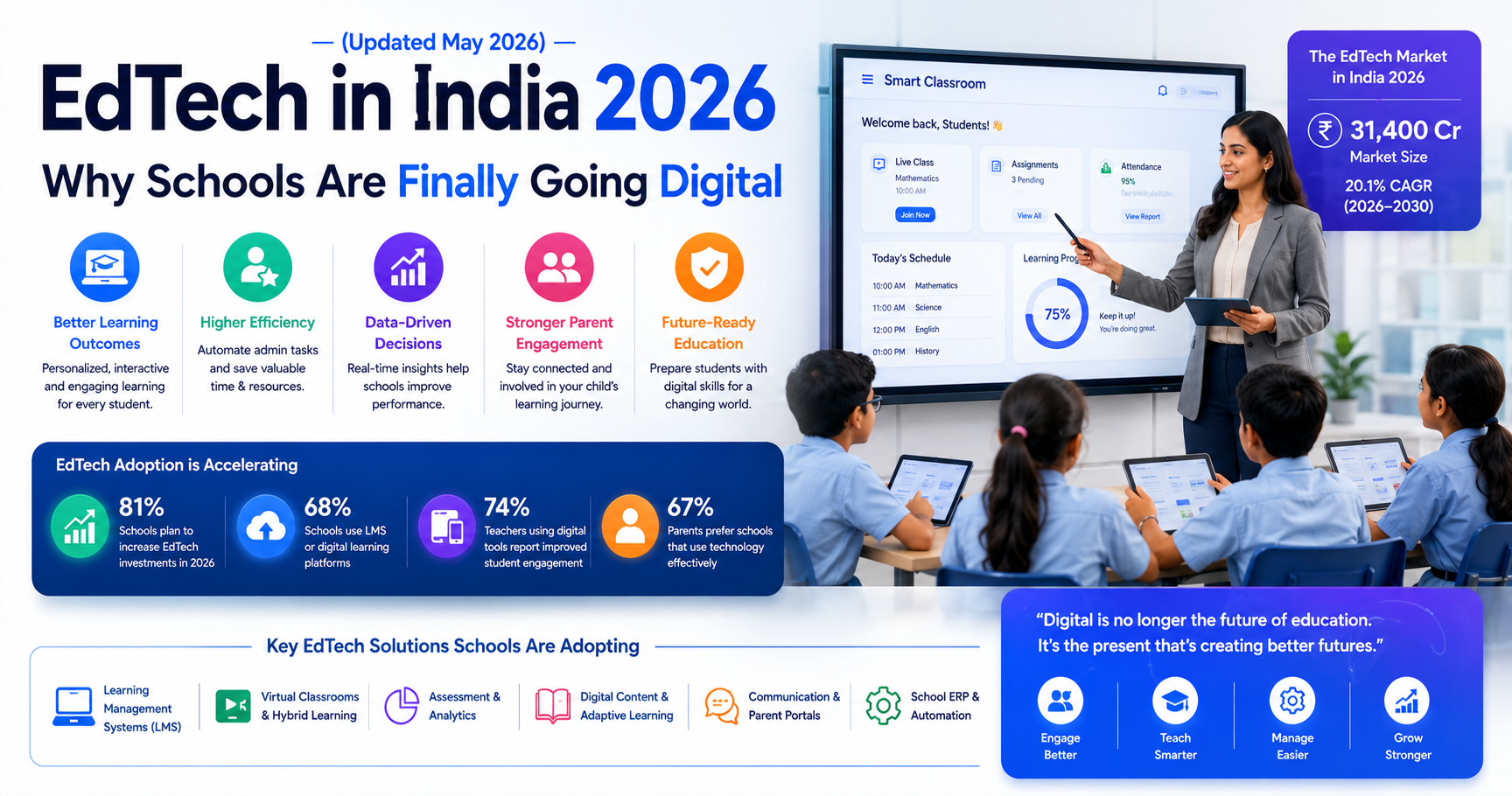
Indian EdTech is a roughly $7.5 billion market in 2025, recovering from the Byju's crash that took the sector from a $4.1 billion funding peak in 2021 to under $320 million in 2023. The pure-play online K-12 model is dead. What is actually driving school digitization now is unglamorous: government rails like PM eVidya and DIKSHA, the NEP 2020 push, an AI curriculum landing in Grade 3 from the 2026-27 academic year, and a "phygital" model that PhysicsWallah proved works. Tier 2 and 3 schools are adopting faster than metros. This is the operator's view, not the hype cycle.
By Manu Shukla, Founder, eCorpIT. Last updated 27 May 2026.
Why "finally"
The headline says schools are finally going digital. That word is doing real work.
Indian schools have been "about to go digital" for fifteen years. Smart boards arrived and gathered dust. Tablets were bought and locked in cupboards. The pandemic forced a frantic shift to Zoom that most schools abandoned the moment classrooms reopened. The 2020-2022 EdTech boom poured billions into apps that parents bought out of anxiety and children stopped opening by week three.
So why is 2026 different? Because the reasons schools are digitizing now are structural, not hype-driven. Government infrastructure has reached a tipping point. The NEP 2020 framework has moved from policy document to classroom mandate. The AI curriculum is becoming compulsory. And the business models have been forced into shapes that actually fit how Indian education works.
The honest version: schools are not going digital because of a brilliant new app. They are going digital because the rails finally exist and the policy finally requires it.
The market reset that had to happen
You cannot understand Indian EdTech in 2026 without understanding what broke in 2023.
Byju's collapsed from a $22 billion valuation to insolvency. The post-mortem, analysed by RAYSolute, points to unsustainable customer acquisition costs, aggressive sales practices, negative LTV-to-CAC ratios, and a basic mismatch between venture-fuelled growth metrics and what Indian families actually wanted from online K-12 education.
The funding numbers tell the story plainly. Inc42 tracked the sector's drop from a $4.1 billion peak in 2021 to $319 million in 2023, with only about $215 million raised through much of 2024. Consolidation followed. upGrad acquired Unacademy in an all-stock deal at a valuation below $500 million, down roughly 85% from Unacademy's $3.5 billion peak.
The deeper shift was psychological. As the market reset analysis describes it, Indian parents moved from "Fear of Missing Out" during the boom to something closer to "Fear of Getting Scammed" by 2024. Unverified certificates, aggressive sales calls and the Byju's headlines did lasting damage to trust in pure-play online education.
Here is why that reset matters for schools. It cleared out the noise. The companies that survived are the ones selling to institutions on outcomes, not selling to anxious parents on fear. That is a healthier foundation for actual school digitization.
What is actually driving digitization now
Strip out the marketing and four real forces are moving Indian schools online in 2026.
Government rails have reached scale. PM eVidya, built on the "One Nation, One Digital Platform" (DIKSHA) and "One Class, One Channel" (Swayam Prabha) principles, is now genuine infrastructure rather than a pandemic stopgap. Luneblaze's overview notes the DTH channel offering has expanded to 200 channels covering grades 1 to 12, with lessons delivered in multiple Indian languages for students without internet access. DIKSHA serves content in over 130 languages.
NEP 2020 has moved from policy to practice. The National Education Policy is no longer a document being debated. As Organiser reported, it is reshaping classrooms, assessment and teacher training across states. Schools that ignored it in 2021 are now being measured against it.
Teacher capacity has been built. Through NISHTHA, over 14 lakh teachers have received structured training, per the same coverage. Digital adoption fails without teacher buy-in. This is the least visible and most important enabler.
The AI curriculum is becoming compulsory. India plans to roll out an AI curriculum across all schools starting from Grade 3 in the 2026-27 academic year, aligned with NEP 2020 and the NCF-SE 2023, as Ministry of Education guidance indicates. When AI literacy becomes a curriculum requirement, every school needs a digital answer. That single policy decision will do more for school digitization than a decade of app marketing did.
The pattern: the push is coming from policy and infrastructure, not from consumer demand. That is exactly why it will stick this time.
The phygital model won
The single most important business lesson from the reset is that pure-play online K-12 does not work in India. The model that won is "phygital."
PhysicsWallah is the canonical proof. As the 2026 market analysis documents, PW validated the combination of offline learning centres with digital content delivery, and that hybrid model has replaced pure online as the dominant viable approach in Indian K-12.
The reasons are specific to India. Indian families want a physical anchor: a teacher to hold accountable, a centre to visit, a peer group their child sits with. They also want the reach, recording and affordability that digital provides. Phygital gives both.
For schools, the implication is direct. Digitization is not about replacing the classroom. It is about augmenting it. The school that buys an "online learning platform" and expects it to replace teaching is repeating the Byju's mistake at institutional scale. The school that uses digital tools to extend what good teachers already do is the one that gets results.
The blended model is now standard across coaching centres, colleges and private institutions, a shift MarketsandMarkets attributes to the search for accessibility without losing personalized engagement.
What "going digital" actually means for a school
"Going digital" gets used to mean everything and nothing. Here is what it concretely involves for an Indian school in 2026, in rough order of impact.
Administrative digitization first. Attendance, fee management, parent communication, report cards, timetabling. This is unglamorous and it is where the fastest return lives. A school that digitizes admin frees up hundreds of teacher-hours a month. Tools like the ones Inforida describes for Tier 2/3 schools start here.
Content and curriculum delivery. DIKSHA-aligned digital content, smart-board lessons, recorded material for revision, language flexibility for regional-medium schools. The government rails do a lot of the heavy lifting here at zero licensing cost.
Assessment and diagnostics. Digital tests, item analysis, learning-gap identification. This is where AI starts to earn its place, automating the diagnosis and targeted-practice work that used to eat teacher time.
Personalized learning paths. Adaptive practice that adjusts to each student's strengths and gaps. Genuinely useful, frequently oversold. Works best as a supplement to teaching, not a replacement.
Parent engagement. Real-time updates, progress visibility, fee reminders, two-way communication. In the post-Byju's trust environment, transparency with parents is a competitive advantage, not an overhead.
The mistake schools make is starting at the bottom of that list (flashy personalized learning) instead of the top (boring admin digitization that actually pays back).
AI in the Indian classroom: signal versus noise
AI is the loudest topic in Indian education right now. Some of it is real. Plenty is sold ahead of what it can deliver.
What is genuinely working in 2026.
Administrative AI. Automated scheduling, fee follow-up, parent-query handling, document generation. The clearest return, the least controversy.
Diagnostic and practice AI. As industry forecasts describe, traditional tuition is unbundling, with routine functions (diagnosis, repetition-checking, targeted practice) migrating to AI systems that give on-demand attention. This frees the human teacher for the parts that need a human.
Language and access. AI translation and regional-language content generation is opening material to students who were locked out by English-only resources. In a country with India's language diversity, this is a bigger deal than most international coverage recognises.
The compulsory AI curriculum. Grade 3 onward from 2026-27. This is not AI teaching students; it is students learning about AI as a literacy. It is also the policy lever forcing every school to build digital capacity.
What is being oversold.
Fully autonomous AI tutors replacing teachers. The technology is not there, the trust is not there, and the Indian classroom context (large classes, mixed levels, exam pressure) is not suited to it. AI as a teacher's assistant works. AI as a teacher replacement does not.
AI-generated content with no human review. The same hallucination and quality issues that affect every other domain apply here, with higher stakes because the audience is children.
The honest framing: AI in Indian schools in 2026 is a force multiplier for good teachers and good administrators. It is not a substitute for either.
The Tier 2 and Tier 3 surprise
The conventional assumption is that metros adopt technology first and smaller cities follow. In Indian school EdTech in 2026, that assumption is wrong.
Inforida's field view is that Tier 2 and Tier 3 schools are embracing AI in education faster than many urban counterparts. Schools in smaller but fast-growing cities are adopting AI tools at a surprising pace, using them to modernize administration, personalize learning and strengthen parent engagement.
A few reasons this is happening.
Metro schools are often locked into legacy systems and entrenched processes. A Tier 2 school digitizing for the first time has no legacy to fight. It leapfrogs.
Affordability has crossed a threshold. As AI tools have gotten cheaper and easier to deploy, the cost barrier that kept smaller schools out has largely fallen.
The parent aspiration is intense. Families in Tier 2 and 3 cities are highly motivated around education as a path to mobility. A school that visibly modernizes earns enrollment.
For EdTech companies and for schools, this reorders the go-to-market. The early-adopter school in 2026 is as likely to be in Indore, Coimbatore or Lucknow as in Mumbai or Bengaluru.
The infrastructure reality
None of this works without the basics, and the basics are still uneven.
The scale of the gap is large. India has about 1.5 million schools, and while over 100,000 had adopted digital tools by 2024 per market estimates, only a fraction have meaningfully integrated EdTech beyond government-mandated platforms. The runway is enormous and so is the gap.
Three constraints to plan around.
Connectivity. Still patchy in rural and many Tier 3 areas. This is exactly why PM eVidya's DTH television channels matter; they reach students who have no reliable internet. Any school digitization plan that assumes universal broadband will fail in large parts of the country.
Devices. Shared-device and lab models still dominate outside affluent schools. Solar-powered digital setups are being deployed in some rural schools to work around power reliability, as documented in coverage of the rural-urban divide.
Teacher capacity. The single biggest determinant of whether a digitization effort succeeds. NISHTHA's 14 lakh trained teachers is real progress, but training has to be ongoing, not one-time. The schools that succeed treat teacher enablement as the core of the project, not an afterthought.
A useful rule for any school or vendor: design for the constraint, not the ideal. The plan that works in a well-funded Delhi private school will not work in a government school in rural Bihar. The infrastructure reality has to lead the design.
The new funding and business landscape
The capital environment in 2026 is leaner and, most operators agree, healthier.
Inc42's read on a possible comeback is cautiously optimistic: EdTech is back in VC pipelines, but the bar has changed. Leaner business models, niche offerings, real AI integration and a clear path to profitability are now table stakes. The growth-at-all-costs era is over.
The market opportunity itself is real and large. The India EdTech market sat at roughly $7.5 billion in 2025 and is projected toward $29-33 billion by the early 2030s at a CAGR near 28%, per MarketsandMarkets. But the honest sub-figure matters: the actual direct-to-consumer online K-12 slice is estimated at only $2-3 billion, a fraction of the $90 billion-plus figures that venture capitalists threw around during the boom.
The implication for where the money is going: B2B and B2G (selling to schools and governments) is now more attractive than B2C (selling to parents). Institutional sales have longer cycles but far better retention and unit economics. The companies raising in 2026 are mostly selling into schools, not advertising to families.
What schools get wrong
From digitization projects we have seen up close, the same mistakes recur.
Starting with the flashy thing. Schools buy a personalized-learning platform before they have digitized attendance and fee management. The return is inverted. Start with admin.
Treating it as a procurement decision, not a change-management project. The tool is 20% of the work. Teacher training and process change are the other 80%. Schools that buy software and skip enablement get cupboards full of unused hardware.
Assuming connectivity that does not exist. Plans built for ideal infrastructure fail in real Indian conditions. Design for the actual bandwidth and devices available.
Ignoring the government rails. DIKSHA, PM eVidya and Swayam Prabha provide enormous free content and infrastructure. Schools that pay for licensed content they could get free from government platforms are wasting budget.
Buying for parents' anxiety instead of students' outcomes. The post-Byju's environment punishes this. Parents in 2026 are sceptical. Outcomes and transparency win; fear-based selling does not.
One-time training. Teacher capability needs continuous support, not a single onboarding session. Budget for ongoing enablement.
The 90-day school digitization playbook
If you run a school or a school group and want a place to start, this is the sequence we would run.
Days 1-14: baseline and prioritise.
Map what you already have. Hardware, software, connectivity, the actual usage of each. Survey teachers honestly on confidence and barriers. Identify the single highest-pain administrative process (usually fees or parent communication). Audit which free government rails (DIKSHA, PM eVidya) you are already entitled to and not using.
Days 15-45: digitize admin first.
Ship one administrative win: digital attendance, fee management or a parent communication app. Pick the one with the most teacher and parent pain. Train the staff who will use it daily. Measure the time saved. This early win builds the credibility for everything that follows.
Days 46-75: layer content and assessment.
Integrate DIKSHA-aligned digital content into one or two grades or subjects as a pilot. Add digital diagnostics for one subject to identify learning gaps. Keep it small and measured. Resist the urge to roll out school-wide before the pilot proves out.
Days 76-90: review and plan the AI curriculum.
Score the pilots on time saved, learning-gap data quality and teacher adoption. Begin planning for the Grade 3 AI curriculum requirement landing in 2026-27. Write the next 90-day plan with the lessons from this one.
The principle throughout: small, measured, admin-first, teacher-led. The schools that try to transform everything at once are the ones that end up with unused hardware and frustrated staff.
Planning a school or institution digitization? eCorpIT helps schools and education groups scope and ship digital transformation, from admin systems to AI-curriculum readiness, designed for real Indian infrastructure. Talk to our team about a roadmap.
What this means for founders, educators and operators
Three honest reads to close on.
The reset was necessary and it is mostly over. The companies and schools moving now are doing so on firmer ground than the 2021 boom ever stood on.
The growth is real but it is institutional. The money and the durable outcomes are in selling to schools and governments, not in advertising to anxious parents. B2B and B2G beat B2C in this cycle.
The policy tailwind is the real story. NEP 2020, PM eVidya, NISHTHA and the compulsory AI curriculum are doing more to digitize Indian schools than any app ever did. Build with the rails, not against them.
If you are building EdTech for Indian schools, or running a school trying to digitize, the work in 2026 is not about chasing the next shiny platform. It is about admin-first discipline, teacher enablement, designing for real infrastructure, and using the government rails that already exist.
Frequently asked questions
A short closing note
Indian schools are going digital in 2026 for reasons that have nothing to do with the hype that defined the last cycle. The rails exist. The policy requires it. The business models finally fit how Indian education actually works.
The schools that get this right will not be the ones that buy the most software. They will be the ones that digitize admin first, train their teachers properly, design for the infrastructure they actually have, and use the government platforms that are already there and free.
If you want a second set of eyes on a school or institution digitization plan, that is what we do.