On this page · 15 sections
- The state of Indian retail in 2026
- The D2C boom and the funding correction
- Quick commerce: brutal economics that still work
- Tier 2 and 3: where the next decade lives
- ONDC: India's open commerce experiment
- The new Indian consumer
- AI in Indian retail: the actual use cases that work
- DPDP Act: what changes and when
- The omnichannel stack for Indian retail in 2026
- The 90-day digital transformation playbook
- Common mistakes we keep seeing in Indian retail
- What this means for founders and operators
- Frequently asked questions
- A short closing note
- References
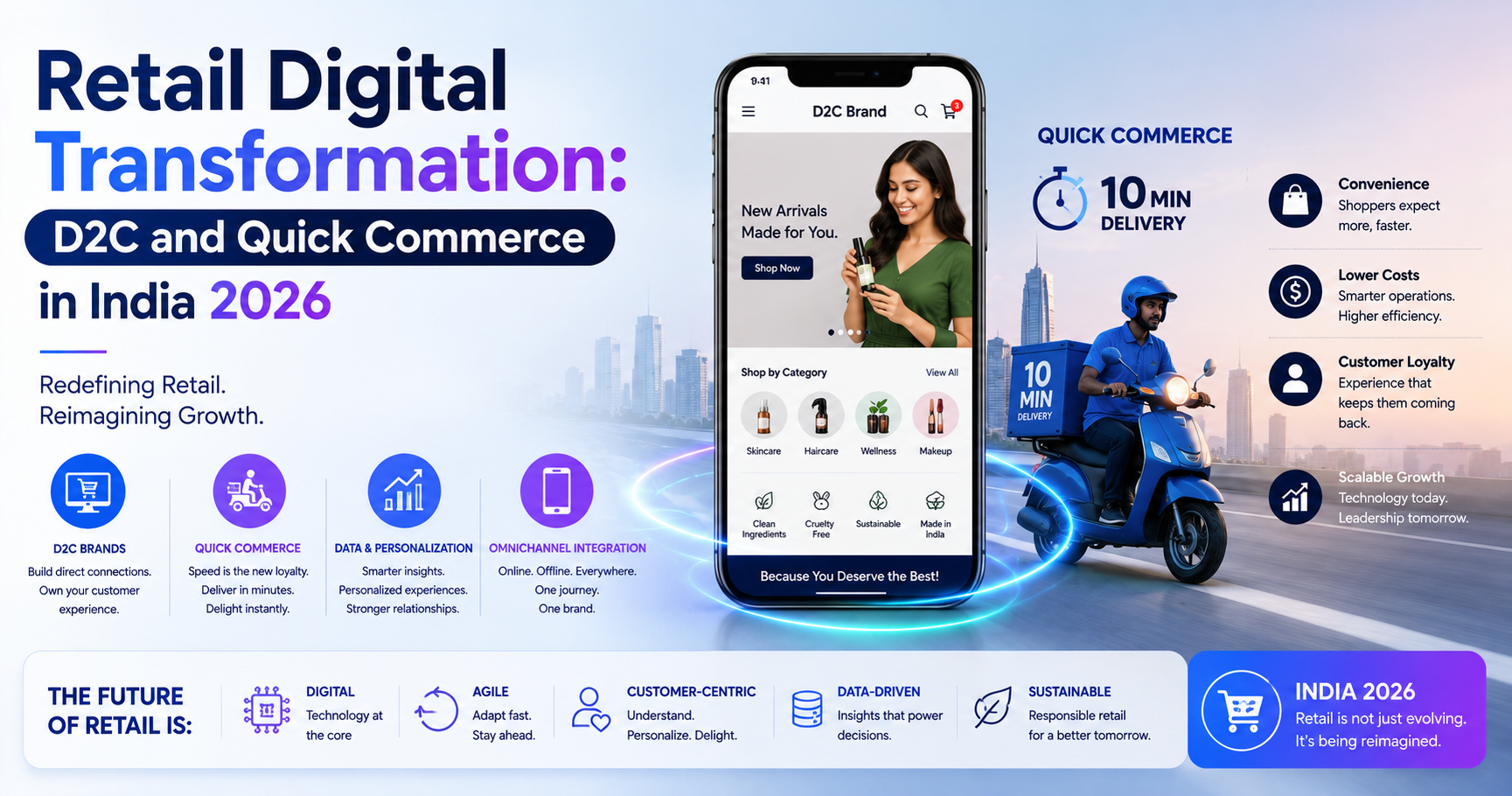
Indian retail is a $1.1 trillion sector running on three rails at once: a $108B D2C engine growing 24% a year, a $5B quick commerce layer that is brutally efficient and still unprofitable for most players, and an ONDC network that has scaled to 7 lakh sellers across 1,200+ cities. The Tier 2 and 3 story is no longer aspirational. It is where most of the next decade's growth actually lives. The DPDP Act phases land in 2026 and 2027 and will reshape how brands collect and process customer data. This is the operator's view, not the deck.
By Manu Shukla, Founder, eCorpIT. Last updated 27 May 2026.
The state of Indian retail in 2026
A few numbers to set the table.
India's overall retail sector sits at about $1.1 trillion, with growth in 2026 expected to be margin-led rather than volume-led for the first time in a decade. The D2C e-commerce slice is worth $108.76 billion in 2026, on track for $322.1 billion by 2031 at a CAGR of 24.3%. Quick commerce, the noisier of the two, sits at roughly ₹40,000 crores ($5B+) in annual GMV and is forecast to reach $30B by FY2030.
The geographic story has flipped. Internet penetration in Tier 2 and Tier 3 cities is now growing at about 30% annually, roughly twice the rate of metros that are saturated. 2025 was widely described as the year of the "Bharat surge." Tier 2 and 3 cities did not just participate in growth. They led it.
The funding climate has tightened in a healthy way. D2C investment slipped to $757M in 2024 as capital became selective. The money that did flow went to companies with positive contribution margins, sustained 15–20% monthly revenue growth and proven retention. A few of the post-2024 funded brands are pointing toward IPOs. boAt filed draft papers in January 2025 at a $300–500M valuation target.
Three rails. Different speeds. Same direction.
The D2C boom and the funding correction
D2C in India had its first real correction in 2024. Most founders we work with treat it as a good thing in hindsight.
The pre-2023 model was simple: raise growth-stage money, burn it on paid acquisition, get to scale, sell to a strategic. That formula stopped working when the cost of capital went up and the cost of Meta and Google ads stayed high. Brands that had not built repeat-purchase economics found themselves stranded.
The brands that came through and are still funded share a small number of traits.
Contribution margin discipline. Not "we will be profitable at scale" but actual unit-level positive contribution. The Mamaearth model of multi-category expansion off a single channel relationship is the canonical example. Started as a baby-care brand in 2016 by Ghazal Alagh and Varun Alagh. Built into a broad personal care portfolio (skincare, haircare, body care) by adding adjacent categories to the same audience.
Retention as the headline metric. Acquisition cost is given. Repeat rate is the differentiator. The strongest portfolios we see now run 35–50% revenue from repeat customers within 12 months. Subscription, replenishment cadence, loyalty mechanics all show up here.
Real omnichannel. D2C-only is a phase, not a strategy. The next stage is general trade, modern trade and marketplace presence, owned with consistent SKUs and positioning. boAt and Mamaearth have both played this aggressively. SUGAR, Plum and The Whole Truth Foods are following the same arc with category-specific adjustments.
Headless commerce and supply-chain automation. The 2025 funding rounds that did close emphasised these two areas heavily. Brands that ship more SKUs faster and integrate cleanly with warehousing and last-mile partners are the ones investors will back today.
The D2C BPC market alone is sized at $5.59B in 2026, on path to $36.30B by 2033 at a 36.6% CAGR. That category remains the most concentrated.
Quick commerce: brutal economics that still work
Quick commerce is the most-watched category in Indian retail. It is also the most misunderstood. Here is the operator's read.
Three platforms hold over 90% of the market in 2025. Blinkit leads with about 50% share after the Zomato integration and an inventory-led pivot that supports private label. Swiggy Instamart cross-sells into a large food-delivery user base. Zepto runs a denser network and the most aggressive category expansion (10-minute meds, beauty, fashion).
The unit economics are uncomfortable to look at. A typical ₹100 order produces:
- ₹40 to ₹50 in delivery cost
- ₹20 to ₹25 in operations (dark store, picking, packing)
- The remaining 25–40% has to cover product margin, marketing and overhead
This is why every operator in the category is obsessed with order frequency and basket size. Blinkit has reported AOV around ₹709, Instamart around ₹619. The frequency model (weekly or twice-weekly orders) is what makes the math work. One-time monthly users do not.
Efficiency is improving in absolute terms. Blinkit cut delivery cost per order by 14% year-on-year to ₹55 ($0.64) by Q4 FY25, mainly through network density and dispatch optimisation. At enough scale, on dense urban grids, profitability is reachable. Outside those grids, it is not.
What this means for brand operators.
Listing in quick commerce is not a marketing channel. It is a distribution decision. Discovery is constrained, search is poor, the algorithm rewards inventory and price.
SKU strategy matters more than brand storytelling. Smaller pack sizes designed for impulse purchase and the "I need this in 10 minutes" use case do well. Large family packs do not.
Promotion economics are unforgiving. Platform commissions plus delivery costs plus mandatory promotional participation can leave brands with single-digit net margins. Model carefully before listing.
Tier 2 expansion is real but uneven. Q-commerce is profitable in dense Bangalore and Mumbai grids. In Tier 2 cities, it is largely subsidised growth. Watch this trajectory carefully through 2026 and 2027.
Tier 2 and 3: where the next decade lives
Most of the strategy conversations in Indian retail in 2026 are about Bharat. The data backs it.
The internet penetration growth rate in Tier 2 and 3 cities is roughly 30% annually, against single-digit growth in metros that are near saturation. Digital advertising spend in non-metros is the fastest-growing line in most agency revenue mix. Same with payment volumes on UPI: most of the marginal user is no longer in the top 10 cities.
A few practical implications for operators.
Language matters more than English-default UX assumes. Voice search, Hindi and regional languages, image-first product discovery. The default English-only checkout flow is leaving conversions on the table in most categories.
Pricing must reflect price sensitivity. The Tier 2/3 customer is not a discount Tier 1 customer. They are a different customer with different willingness to pay. SKU pack sizes, EMI options, COD economics all need to be specifically engineered for this audience.
Distribution is hybrid. Pure-play D2C does not work outside metros at any scale. Marketplace presence (Amazon, Flipkart, Meesho), local kirana partnerships, ONDC participation and offline retail (where unit economics allow) all contribute.
Returns and reverse logistics need design, not afterthought. COD return rates in Tier 2/3 can run 20–35% in some categories. Brands that succeed here design for this from day one with quality control, sizing accuracy, expectation-setting in product pages.
This is the segment most metro-headquartered brands have historically underserved. The brands that get the Tier 2/3 motion right in 2026 and 2027 are likely to be the category leaders in 2030.
ONDC: India's open commerce experiment
The Open Network for Digital Commerce is the most ambitious thing happening in Indian retail right now. It is also the most uncertain.
The numbers are real. As of April 2026, ONDC has onboarded over 7 lakh sellers, operates in more than 1,200 cities and has completed over 150 million transactions. Over 100 buyer applications participate in the network. The growth has been disproportionately driven by Tier 2 and 3 sellers, where commission economics matter most.
For D2C brands, ONDC offers two things conventional marketplaces do not: lower commission overheads (typically 3–8% versus 18–30% on traditional marketplaces) and an open architecture that does not tie the seller to a single buyer-side platform.
What ONDC does not yet offer at scale: brand control, audience data, performance marketing tools. The discovery experience inside most ONDC buyer apps is not yet as sharp as Amazon or Flipkart. For brands that depend on storytelling and merchandising, ONDC is a complementary channel, not a replacement.
The framing we use with D2C clients is straightforward. ONDC is worth investing in as an additional rail. Spend 5–10% of the digital catalogue and operational attention on it. Use the lower commission to test price-elastic categories. Watch the buyer-app landscape mature through 2026. Do not abandon Amazon and Flipkart while you do.
Whether ONDC becomes a UPI-scale success or a partial one depends on whether the buyer-side apps reach genuine product-market fit. That is the variable to watch.
The new Indian consumer
The Indian retail customer in 2026 looks materially different from the customer in 2022.
Roughly 82% of Indian consumers believe AI will significantly improve their purchase experience. That is one of the highest figures globally. Acceptance of AI as a research surface, recommendation engine and chat-based shopping assistant is high.
The buying journey now routinely starts on a non-search surface. Instagram for discovery, YouTube for product reviews, WhatsApp for catalogue browsing, AI chatbots for product comparison. The classic "search on Google, click on result, buy" flow describes a shrinking share of category research in fashion, beauty, electronics and home.
Language preferences are stratifying. Tier 1 customers transact in English by default but consume content in Hindi and regional languages at high rates. Tier 2 and 3 customers prefer native-language transactional flows where they are available. Brands that ship Hindi-default checkout and product descriptions are seeing measurable conversion lift in non-metro segments.
Payment behaviour has converged on UPI for most segments and most ticket sizes. Card and net banking volumes continue to decline as a share of transactions, with COD still meaningful for first-time buyers and in some Tier 2/3 categories.
Trust signals matter more than ever, partly because the noise level has gone up. Reviews, ratings, return policies, named founder stories, behind-the-scenes content, sustainability and ingredient transparency in beauty and food. These are not differentiators. They are table stakes.
AI in Indian retail: the actual use cases that work
AI in retail gets oversold and underspecified. Here is the operator's view of what is genuinely paying back in Indian retail right now.
Recommendation engines. Neural session-based recommendation (the Transformer-derived architecture) has become the 2026 standard. The model weights every click, scroll depth and image hover within a session, builds a high-fidelity intent map in under 50 milliseconds and reconfigures the UI accordingly. Flipkart and Amazon India both run versions of this in production. Mid-size D2C brands using third-party recommendation platforms see typical AOV lifts of 6–14% when implemented well.
Generative product content at scale. AI-generated product descriptions, alt text, category copy, hero banners targeted by buyer segment. A SKU catalogue of 5,000 products that used to take a copy team a quarter to refresh now takes a senior editor and an LLM about two weeks, with human review in the loop. Quality has improved enough that this is no longer a corner-cutting move.
WhatsApp commerce automation. Catalogue browsing, order placement, payment, support, re-order prompts, all inside WhatsApp Business with AI assistance. Conversion rates from WhatsApp campaigns now routinely exceed email for many D2C brands, particularly in beauty, fashion and food.
Pricing and assortment intelligence. Daily competitive price scraping with automated rule-based response, demand forecasting at SKU-store level, replenishment optimisation. The serious operators in fashion and grocery are running this in production now.
Customer service automation. This is covered in detail in our separate pillar. The short version: AI deflects 41% of Tier-1 contacts at median, 50–70% with a well-maintained knowledge base.
The use cases that are oversold in 2026: fully autonomous AI store associates, end-to-end personalised storefronts that change for every visitor (the engineering and content cost rarely pencils out at SMB scale), AI-only product design without human curation.
DPDP Act: what changes and when
The Digital Personal Data Protection Act of 2023 is now in phased implementation. Most retail and D2C operators need to plan against three dates.
Phase I (effective 13 November 2025): Certain provisions relating to the Data Protection Board of India became effective immediately.
Phase II (effective 13 November 2026): Consent Manager provisions become operational. Consent Managers are entities registered with the Data Protection Board that allow Data Principals (the customer) to manage consents across multiple platforms through a single interoperable interface.
Phase III (effective 13 May 2027): All other substantive provisions of the DPDP Act, including specific compliance obligations.
Penalty exposure is real. Up to ₹250 crore for failing to implement reasonable security measures. Up to ₹200 crore for failing to notify breaches or mishandling sensitive data like children's data. Up to ₹50 crore for lesser violations.
What this means for retail and D2C operators in 2026.
Audit your data collection now. Browsing history, purchase patterns, payment details, delivery addresses, location data, device IDs, behavioural analytics. Map every category. Document the lawful basis for processing each.
Consent flows need a rebuild. Granular, purpose-specific, withdrawable. The "I accept" tick-box at signup will not survive Phase III.
Children's data needs special handling. The Act restricts profiling and targeted advertising for children. Brands that serve teen segments need to redesign their personalisation logic.
Ad-tech responsibility now sits with you. The platform is responsible for ensuring ad-tech partners comply with Indian data protection standards, regardless of where the partner is located.
Plan for Consent Manager integration. When the Phase II provisions go live in November 2026, integrating with one or more Consent Managers will be necessary for any brand collecting significant customer data.
This is one of the largest operational changes Indian retail has faced in a decade. Brands that start the audit work in 2026 will have a smooth transition. Brands that wait until April 2027 will not.
The omnichannel stack for Indian retail in 2026
The stack list is long. The shape is consistent.
Storefront layer. Shopify or a Shopify alternative for D2C, a headless CMS for brands at scale. Custom storefront engineering only above a real threshold (₹100 Cr+ revenue or a category-specific need).
Marketplace operations. Unicommerce, GoFrugal or Increff for catalogue sync, order management and inventory across Amazon, Flipkart, Myntra, Nykaa, Meesho, JioMart and ONDC.
Warehouse and logistics. Shiprocket, Delhivery, Shadowfax, XpressBees for last-mile. WareIQ or Fareye for warehouse management at scale.
Payments. Razorpay or PayU as primary gateway. UPI, cards, COD, EMI. BNPL through Simpl or LazyPay for relevant categories.
CRM and marketing automation. Clevertap, MoEngage or WebEngage as the engagement layer. WhatsApp Business via Gupshup or AiSensy. Email/SMS through the same providers or specialist vendors.
Analytics and personalisation. GA4 plus a warehouse (BigQuery is the most common). A BI tool layered on (Looker, Metabase, Hex). A recommendation engine where category economics support it.
Customer service. Freshdesk, Zendesk, Intercom or Helpshift. AI agent layer for Tier-1 deflection.
Compliance. DPDP-ready consent management. A documented data processing register. Vendor due diligence for every third-party processor.
A useful sanity check: most Indian D2C brands above ₹50 Cr ARR are using 18 to 25 tools across the stack. Below that ARR threshold, 10 to 15 is normal. Above ₹500 Cr, 30+ is common but consolidation efforts are usually underway.
Need a stack audit specific to Indian retail? eCorpIT does paid stack reviews for D2C and omnichannel brands with a tool-by-tool spend justification and a 90-day consolidation plan. Talk to our team about a review.
The 90-day digital transformation playbook
If you are a founder, head of growth or head of digital looking at where to start, this is the sequence we run.
Days 1–14: baseline and audit.
- Pull last 12 months of channel-level revenue, blended CAC, contribution margin by SKU, repeat rate by cohort.
- Map every tool, every integration, every owner. Mark each with usage level and spend.
- Audit DPDP exposure. Document what data you collect, where it sits, who has access, what the lawful basis is.
- Audit your top 50 product pages for completeness, schema, mobile speed and language support.
Days 15–45: prioritise and decide.
- Pick three growth bets, no more. Channel, geography, category. Be specific.
- Decide the marketplace and ONDC strategy. Which platforms, what assortment, what pricing logic.
- Lock the Tier 2/3 plan if Bharat is a growth bet. Language, pricing, distribution.
- Pick the first AI use case. Recommendation engine, WhatsApp automation or content generation. One, executed well.
- Start the DPDP audit and consent flow redesign. Phase II is November 2026.
Days 46–75: ship the operating changes.
- Roll out the AI use case to a defined audience segment with a measurement plan.
- Launch the marketplace and ONDC expansion in priority categories.
- Ship the language and Tier 2/3 pricing changes.
- Begin DPDP remediation: update consent flows, document processing, vendor due diligence.
Days 76–90: measure and plan.
- Score every initiative: contribution margin impact, retention impact, CAC impact.
- Run one incrementality test on the highest-spend acquisition channel.
- Write the next 90-day plan with a sharper hypothesis.
- Schedule the quarterly DPDP review.
The cadence compounds. Each quarter the plan gets sharper because the data is better.
Common mistakes we keep seeing in Indian retail
A short list from audit work over the past 12 months.
Optimising for GMV over contribution margin. GMV without margin is a vanity number. The 2023–2024 funding correction punished this hard.
Treating quick commerce as a marketing channel. It is a distribution decision with specific SKU and pricing implications. Listing without redesigning for the channel produces single-digit net margins.
Ignoring ONDC because it is early. Free option value with low downside. Start small, learn the operating model, scale as buyer apps mature.
English-first UX in Tier 2/3 expansion. Conversion is being left on the table in every category that has not localised checkout, product descriptions and customer service.
Underinvesting in retention. Customer acquisition is taxed. Repeat purchase economics are the differentiator. Most brands spend 80%+ on acquisition and under 20% on retention.
Treating DPDP as an IT problem. It is a product, marketing and operations problem. The compliance work touches consent flows, ad-tech partners, vendor contracts and data warehouse design.
Buying tools before defining the use case. "We bought a CDP because we should have a CDP" is a real conversation we have. Pick the use case first. Pick the tool to fit it.
What this means for founders and operators
Three honest reads to close on.
The capital cycle is healthier now than it was two years ago. Selective funding has rewarded discipline. The brands that come out the other side are stronger.
The Tier 2/3 opportunity is genuine and underserved. The brands that engineer specifically for this customer (language, pricing, pack sizes, COD economics, reverse logistics) will define the next decade of Indian consumer.
The platform shifts (ONDC, DPDP, AI as a research surface) are all real. They are not all on the same timeline. Plan against the dates that matter for your stage.
If you are building or scaling a retail or D2C brand in India in 2026, the work is not about chasing every trend. It is about picking three growth bets, instrumenting honest measurement, and executing the operating discipline most teams skip.
Frequently asked questions
A short closing note
The Indian retail story in 2026 is not a single trend. It is four trends running in parallel: D2C maturing, quick commerce industrialising, Bharat accelerating, ONDC scaling. All against a regulatory shift that is the most consequential in a decade.
The brands that win will not be the ones that chase every trend. They will be the ones that pick three growth bets, instrument honest measurement, and run the operating discipline most teams quietly skip.
If you want a second set of eyes on your 2026 plan, that is what we do.